It’s Saturday morning in late summer after an unusually busy work week. I sleep in until 9 but I’m still sluggish throughout the first paces of the day. I could have slept for a month but that’s off the table because here in Montana it’s practically a race to take advantage of the brilliant weather before winter comes.
My friend Ryan Stewart wants to get back out on the rock for the second week in a row. He’s eager to make up for his two year hiatus from climbing. My response to his climbing proposal is an earnest, “I’d love to!”
We go to Gallatin Tower, the most classic roadside crag in the Bozeman area. Our plan is to spend the afternoon cruising easy grades. At the base of the tower, we pass a pack of college students making fits and starts up the test piece, Bowling for Buicks. They look young, ambitious, strong. Ryan and I continue ahead to set up on the Guide Route where we’ll warm up.
The climbing is easy but enjoyable. The first two pitches voyage up a series of giant stair-like ledges and then the climbing switches to a generous crack running up the airy arete that defines this face of Gallatin Tower. Exposure begins adding spice to easy climbing. As I mount a small, featured pillar, I poke my head around to the side of the arete and my face is buffeted by a cool gust of wind whistling through a deep notch below me that provides a clear view of crystalline waters coursing along the canyon bottom. A pinch of vertigo claws at my stomach and a short jolt of adrenaline punches into my veins. I take a deep breath and move up.
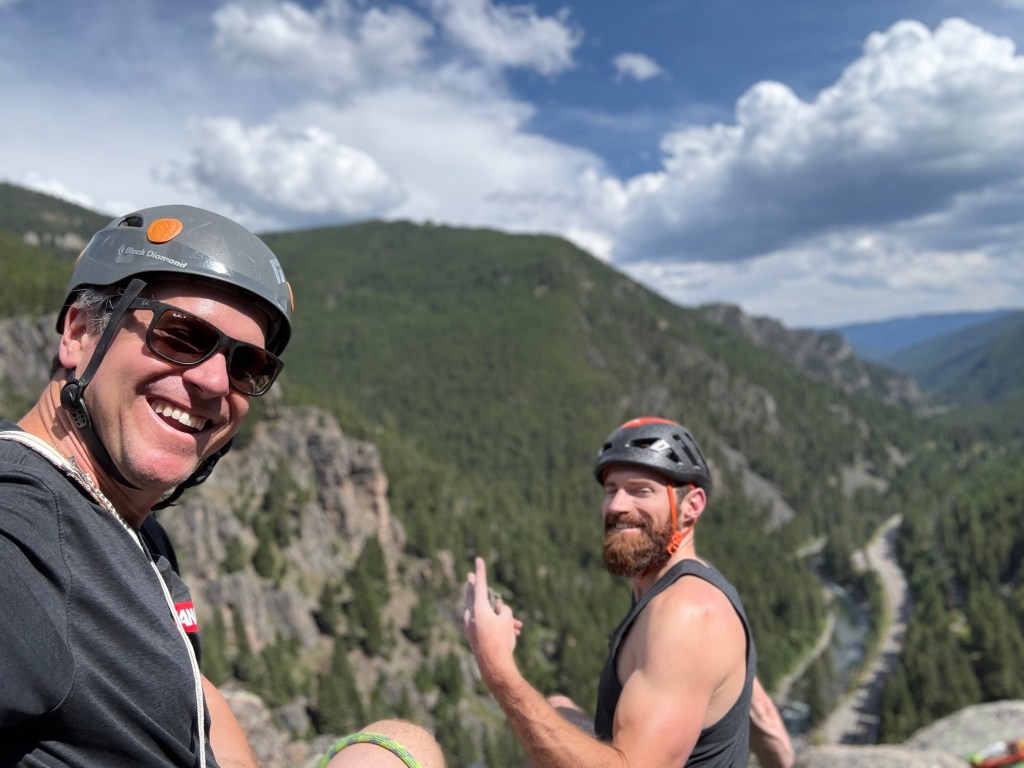
Topping out the Guide Route.
The Guide Route was good, and we want more. We settle on climbing the Standard Route. I know this route will humble us even as I approach it casually, too casually. Ryan is getting back into climbing and I have some of my own challenges today–occasional stabbing knee pains, slow reflexes, and a partially healed tibia after my severe leg break 7 months ago. Nevertheless, I know I will need to lead the 150′-long 5.8+ trad pitch. That grade brings pressure; even though the holds are good, they may not be great, and none of the potential falls will be clean.
Ryan cruises up the first pitch and establishes the belay. It’s perfect climbing, really: big blocky steps, juggy laybacks, and fist sized cracks in bulletproof gneiss. It’s safe to say that he enjoys this pitch. I have a comfy time following him up on top rope, and I revel in the feeling of good holds and the meat of my palm pressing into cool rock in perfect hand jams. Feeling the grit of the rock grounds me and brings me to the present moment. At the belay station, I grab handfuls of nuts, cams, and alpine draws off his harness, quickly clipping them to mine. I have a double rack of cams because the next pitch is a rope stretcher centering on a flaring crack system that eats cams but spits out nuts. As I rack up, I miss three draws on his harness, which I regretted later as my gear dwindled.
This next pitch is tried and true trad climbing. In many places, I start feeling run out and I find tensioned stances to plug gear–I can ease into comfier stances on smaller holds once I feel well protected. Then I can shake out, and continue on my way up. Along the way, I jam my body into a number of unkind positions and places, working my muscles against the rock. There’s such a strong dichotomy in grading between extremely hard sport routes on vertical stone with good protection compared to gnarly sandbagged trad routes like this one: despite their softer grade, they’re so much scarier.
I resume the sharp end for the final pitch up a chimney that splits open a roof above our position. Once I’ve gained the chimney I find good holds for my feet and press my back into the wall for security. My protection, five feet below me, does nothing to assuage the stress of hanging in free space twenty feet above a pile of ledges and boulders. I hastily jam in a green cam near my chest and clip to it as Ryan shouts up to me, “it’s starting to rain!” The cam is unlikely to walk and I don’t extend the clip with a sling, favoring a push through the final moves and up onto the ledge above, where the skies open up and water pours forth. The rain has been coming fast and hard this time of year.
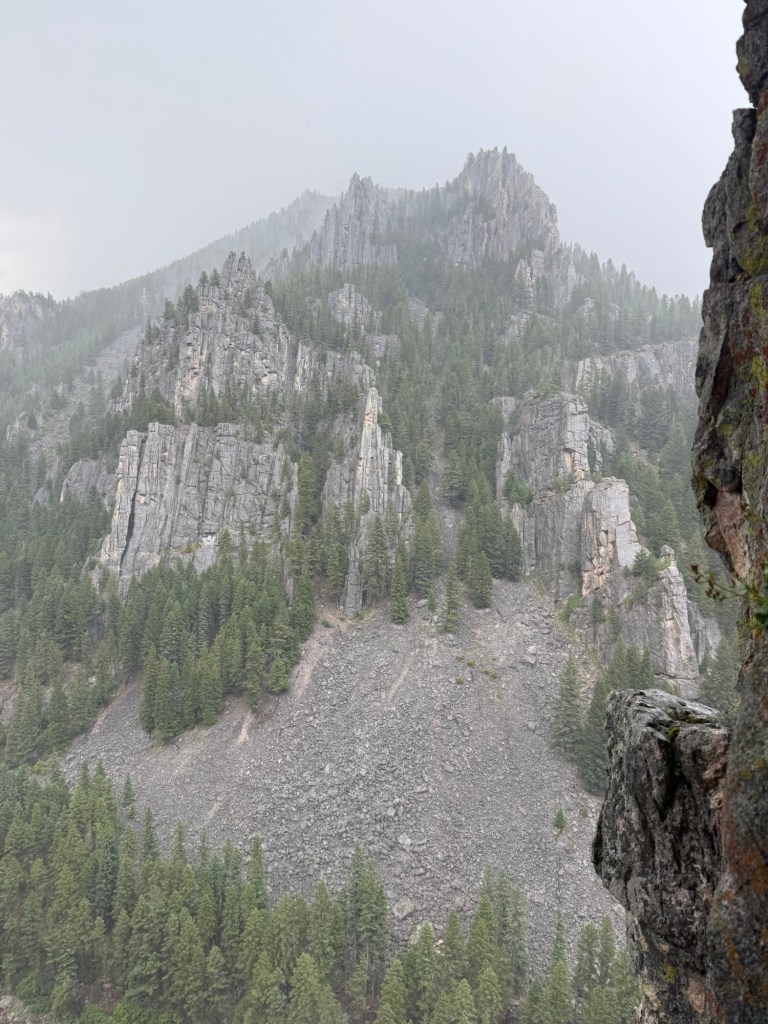
Rain washes against Gallatin Tower. I look onwards to watch a large, swirling storm system roil between the canyon walls. Cloud ribbons coil their way down to the river. The thousand foot tall sheets of rain slide along wind currents and occasionally blow straight into us. My elevated view gives me a three dimensional perspective of this living, breathing storm. At this point, the water feels warm to me and I briefly savor my experience despite the danger these elements bring. After a few lightning strikes, things calm down and the skies clear up.
It seems to me that our quickest way out of this situation will be taking the familiar double rappel off the backside of the tower. This means we must keep going up. I make my way through the last ten feet of extremely wet and slippery climbing. I place gear every three feet in case I pop off a hold unexpectedly.
Now, the rain begins again in earnest. I set up a stout anchor for Ryan. We shout at each other and words can’t be made out but we understand the cadence and ritual of our acts, which give meaning to the muddled shouts that were likely to be: “Off Belay, Ryan.” “Asa: Belay is off.” “That’s me, Asa!” “You’re on belay, Ryan.” “Climbing!” “Climb on!” and “This is f**ing nuts man!” as Ryan begins to swim his way up greasy rock.
Summiting the tower, we make our way to the rappel station. “It’s starting to hail…” I observe with little emotion. Ice nuggets mix in with the rapidly cooling water cascading over us. Our shaking fingers and chattering jaws carry us through the motions of untangling soggy, reluctant rope, and threading it through the rappel rings. The rope is pretty tangled because…of course it is! Because of Murphey’s Law. I motion for Ryan to go down first and then I do not leave this spot for several long minutes while I wait and try to protect myself.
I hold still up there, crouched down on top of Gallatin Tower, my back is turned against the onslaught. Ice ricochets off my climbing helmet with loud snaps. Lighting and thunder become trivial: perhaps it was there, perhaps not. I shield my neck with my hands. The hail gets larger and I see one-half inch diameter ice pellets slam into my ten foot wide rock perch and bounce around like some crazy dance. The ice begins to bruise my knuckles. I turn my hand over and protect myself with my palm facing up–complete subservience to the heavens. I’m getting absolutely blasted up here. If the hail gets any larger I’m in a really bad position. “Hail storms are usually short, aren’t they, aren’t they?” I ask myself twice before giving up that line of thought.
Brief moments draw out. I wonder about the path that led me here and about the meaning of this moment. I try to rationalize my experience but quickly realize I can’t understand it. This moment simply *is* and I lean into this moment with acceptance and a will to endure. This level of immediacy and exposure to danger is not new to me. I’ll reflect on better preparation later.
Extreme danger reveals a lot about people and in a potentially devastating manner, but I learn that Ryan has a very good head on him and he executes his rappel flawlessly. Now it’s my turn to go down.
The rope is stretchy and heavy. I try to make sure it goes over the edge in a place it won’t get stuck in a crack but I’m feeling really bad about getting our rope down. Getting it stuck would be heartbreaking because we still needed to complete another rappel after this one. However, I don’t fuss with the rope any more because it’s too dangerous to spend more time up here and I need to leave. I’m overjoyed bailing off the side of the tower and out of the most severe exposure.
Waves of chill pass through our bodies between the rappels. Our first attempts to pull the rope down are fruitless, I’m starting to think that the rope won’t come down at all and wonder if there’s an alternate walk off from here. Fortunately, Ryan keeps working on the rope, finds another angle to pull from, and soon we’re making arm lengths of progress at a time–two grown men putting all their weight into it. The physical exertion brings wonderful warmth to our arms and hands.
We rig up the last rappel and this time I get to go first. The cold is constricting my vision, making it hard to see where I’m headed. I keep blinking and squinting my eyes. But I’m not worried because my hands feel secure on the rope tails. And then I touch the ground and my spirits are lifted with relief. Ryan reaching the ground is even better. I don’t even care if the rope is stuck at this point but we manage to get it down anyways.
No feeling like making it off the rock after weathering a hail storm.
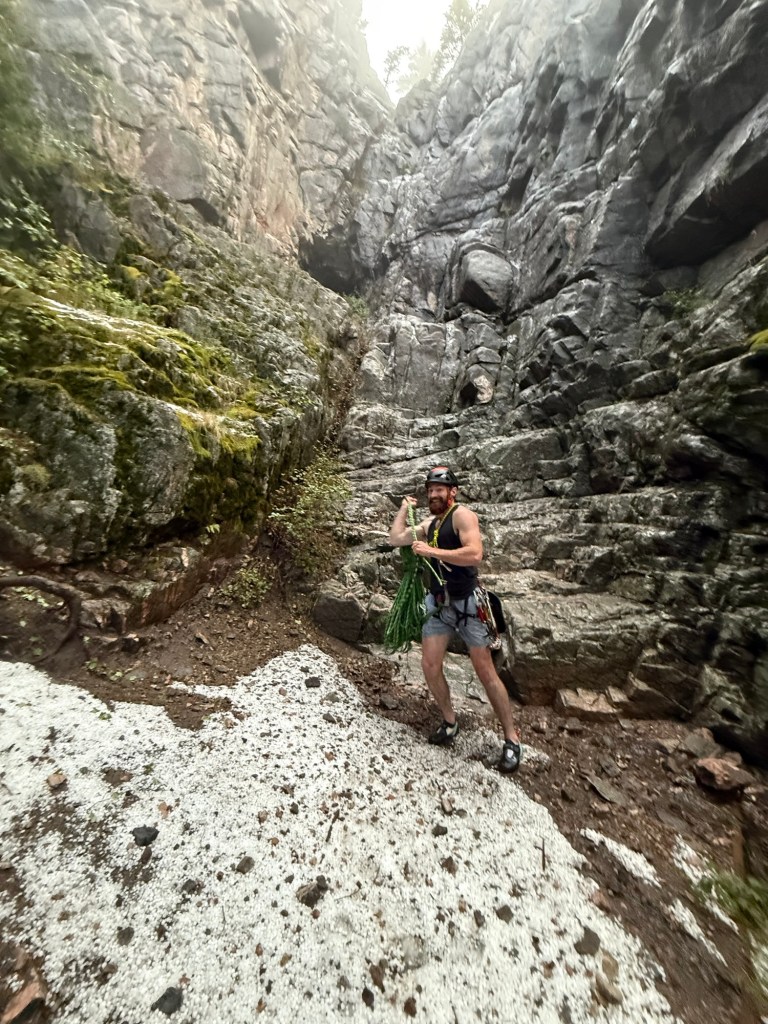
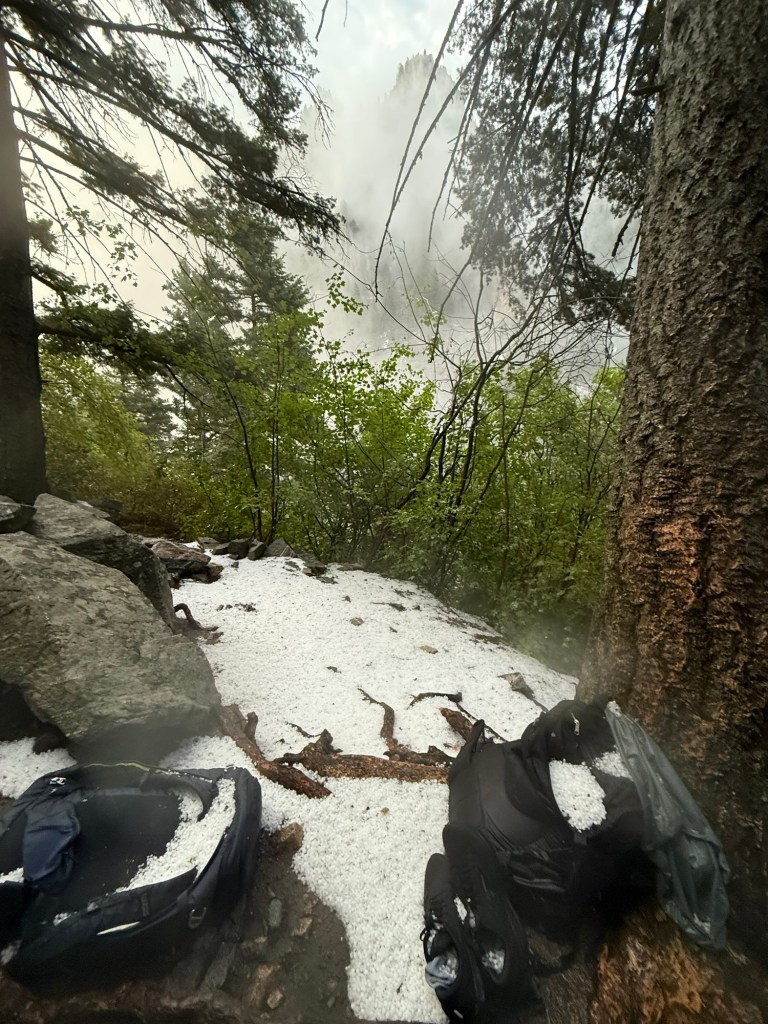
Our packs at the base are full of hail and ice water. For the first time ever, I opt to stay in my undersized, downturned climbing shoes all the way back to the truck. Ryan puts on tennis shoes and discovers one last treat: the toes are packed with hail. When I finally try to put on my flip flops, after several failed attempts, I must look down at my feet to make sure my shoes go on all the way because I don’t have enough sensation in my feet to tell otherwise.
Plenty of hail to take home with us. I hope our gear dries out!
We high-five at the road and a passer-by snaps a picture of us descending out of the maelstrom aftermath. I feel exhausted, accomplished, and pleased to be alive, and I feel that any bad karma I may have had was surely purged by the hail on top of the tower. This is type III fun epitomized and I’m glad to have a good comrade to get through it with.
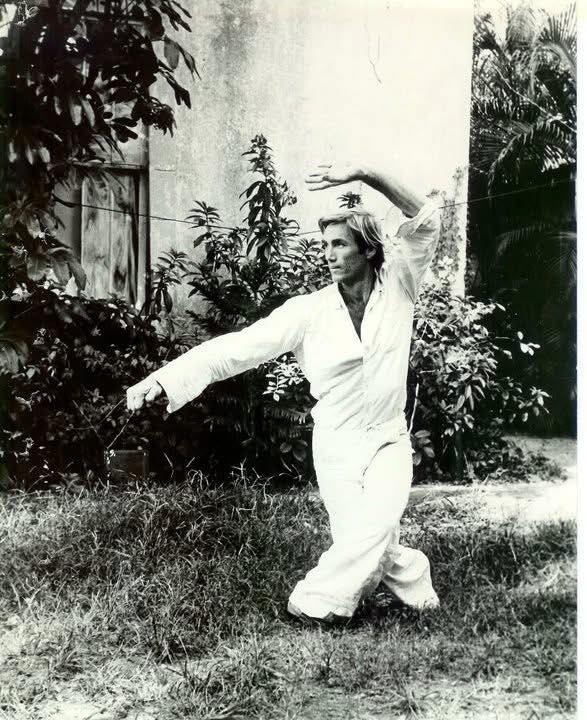
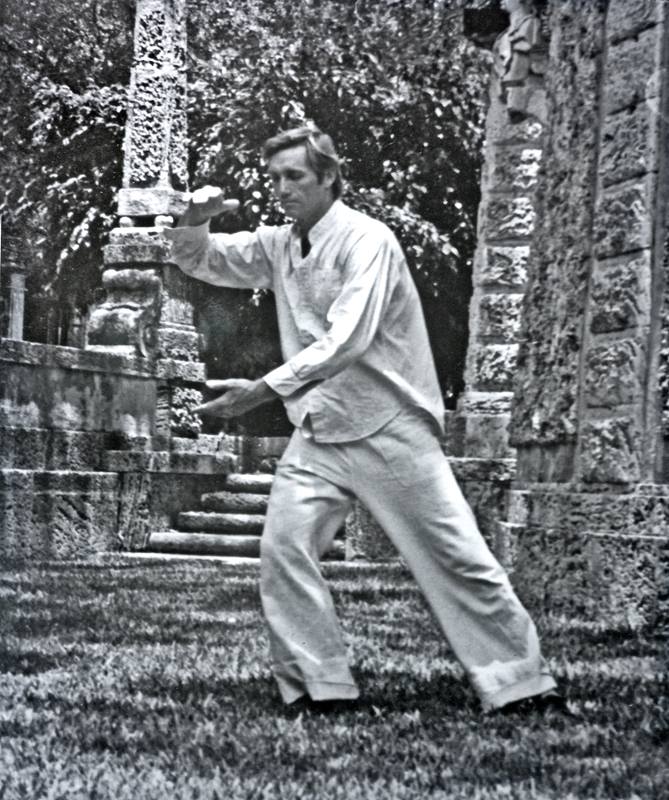
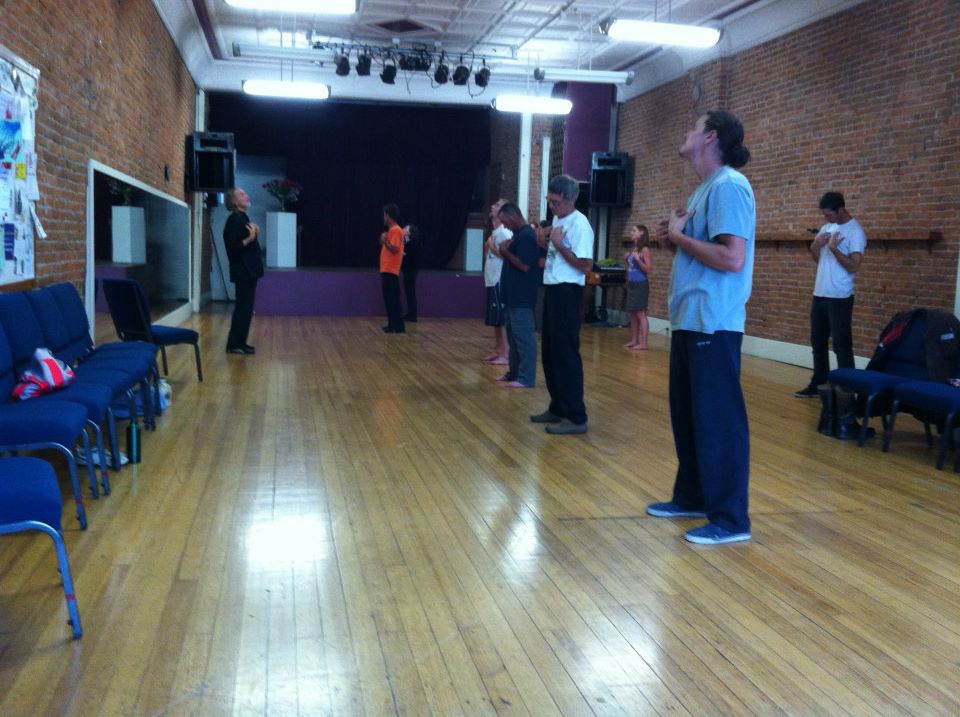
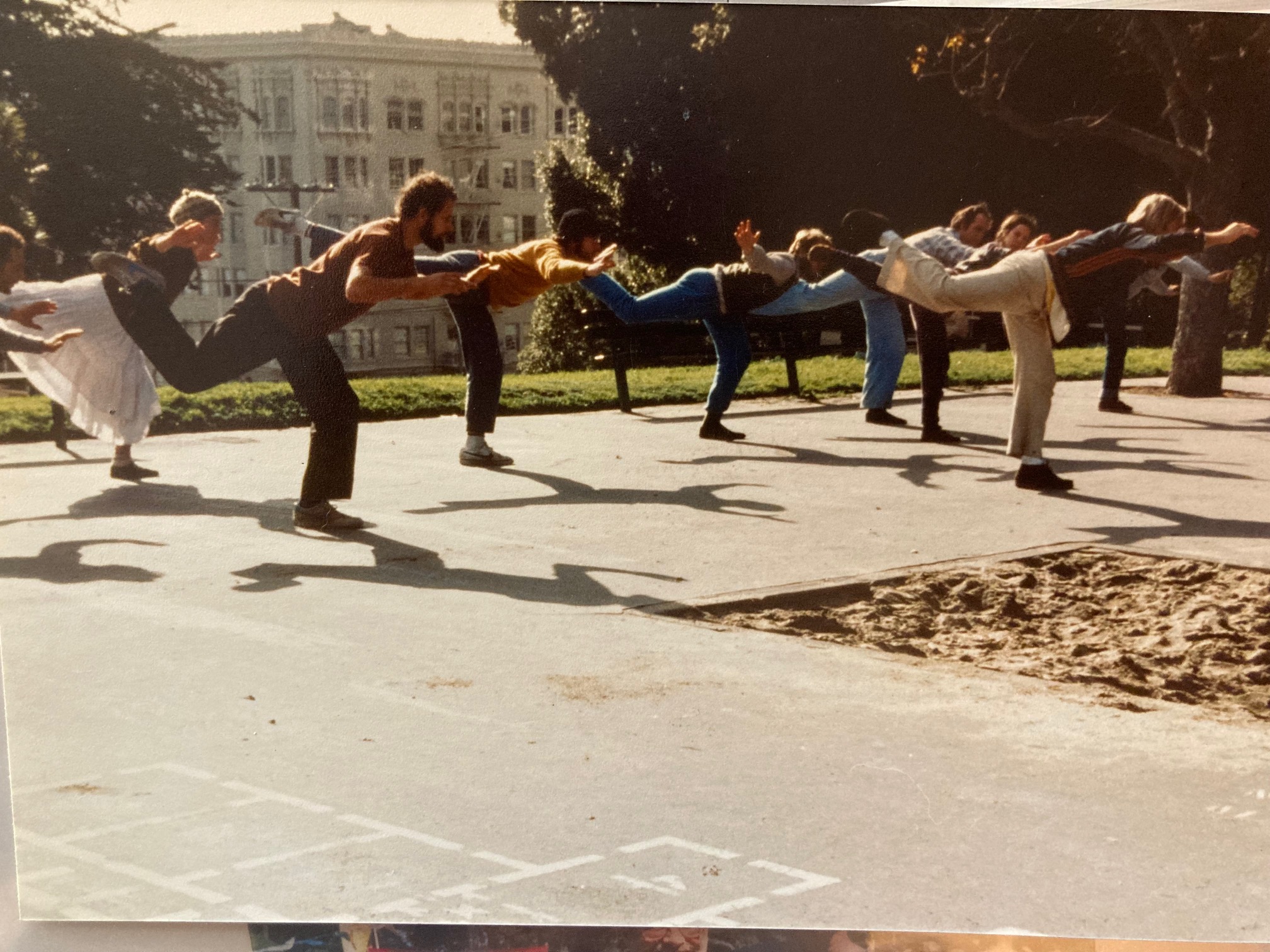
Sifu Bob Cookpracticing Tai Chilong before I knew him.
When I learned you passed, shreds of memory pressed in on my mind.
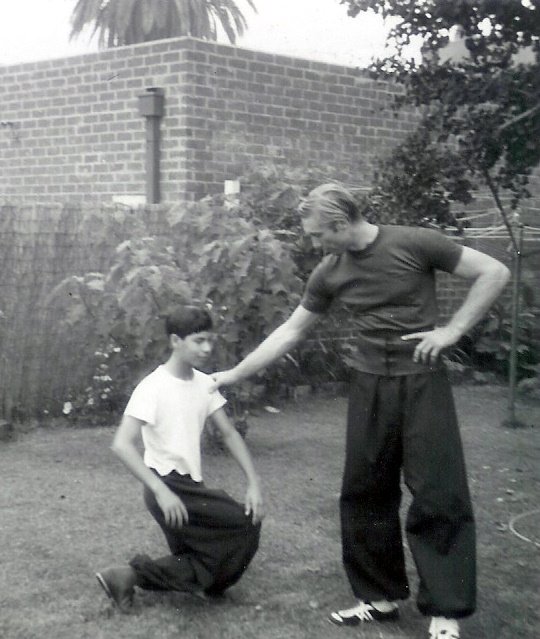
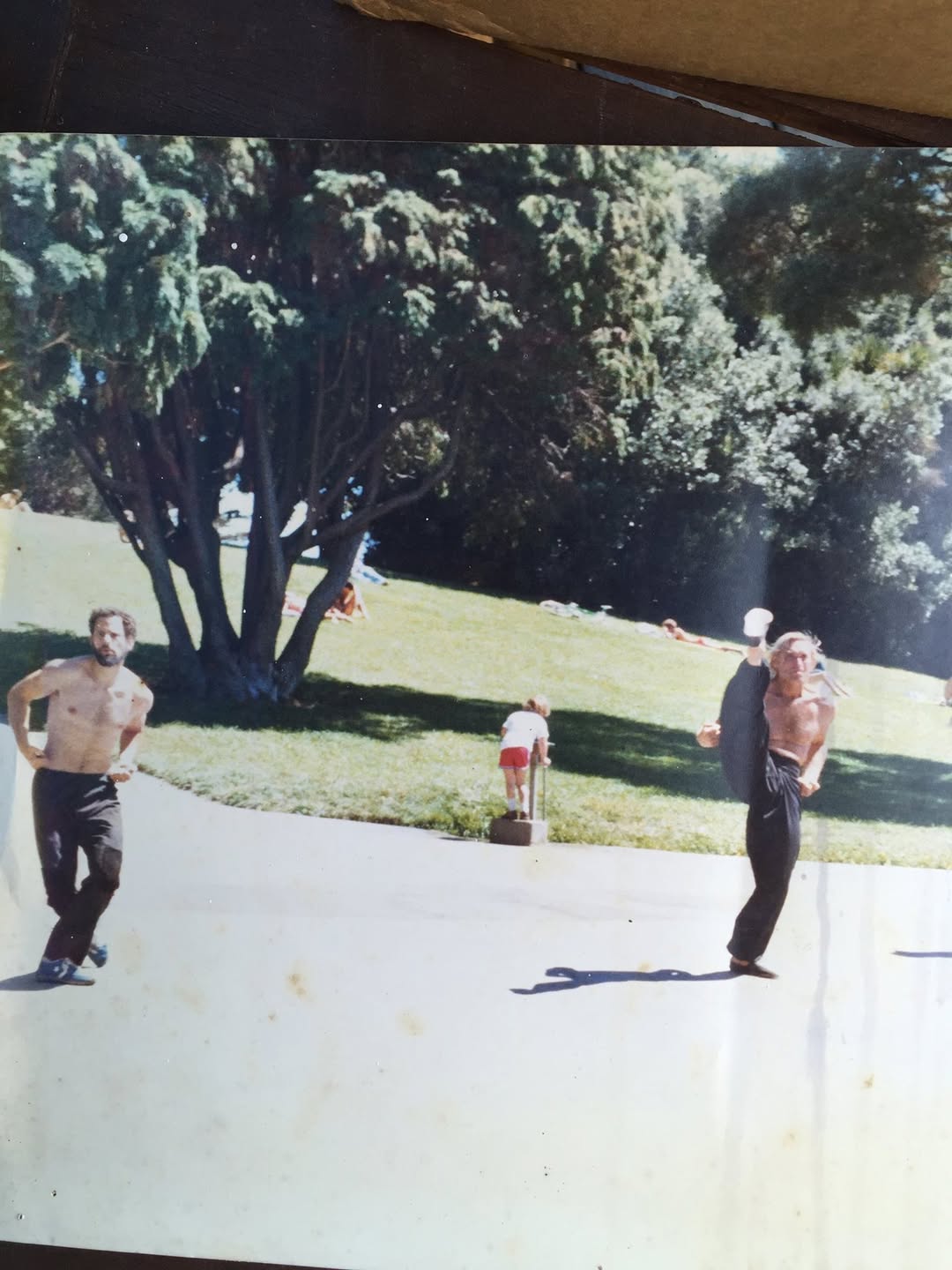
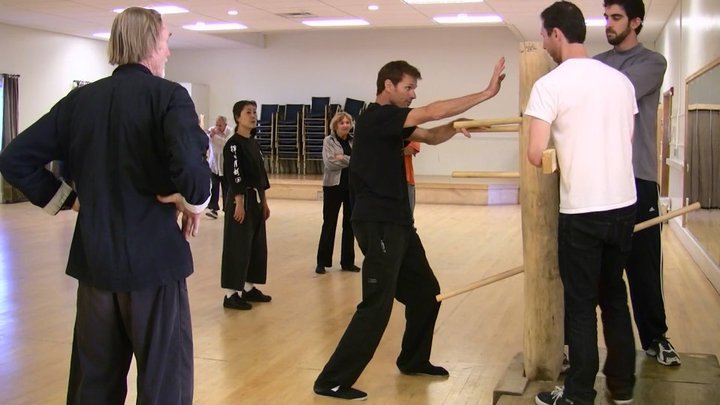
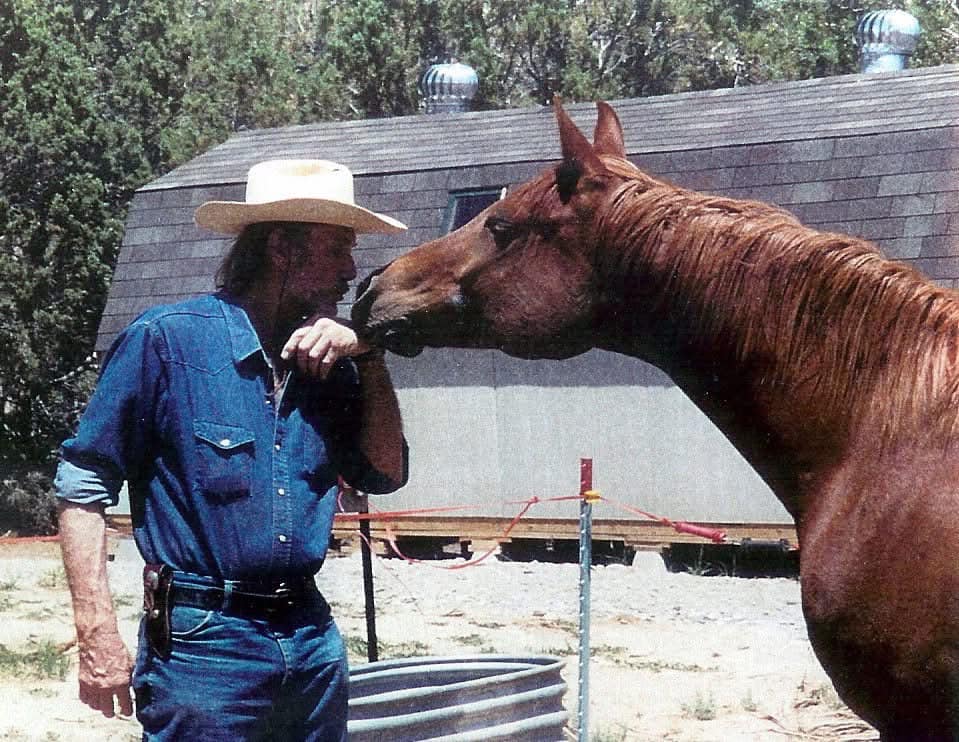
The feeling of pushing back against your forearm is like pushing against a rock. Decades of tempering your limbs by beating them on bags of sand, then bags of rocks changed your body. You cut apart old jeans and filled them with pebbles, then pounded them to dust. All these years, you never stopped. Your habits could seem normal in a Shaolin temple–incomprehensibly on the other side of the world, poorly interpreted through the pages of weathered, yellow National Geographic magazines–but here in a backwater Colorado town, your lifestyle is mystical. One time, you fell backwards and slammed the back of your head on the edge of your porch. You were in your seventies and you lived alone (with your horse, but he wouldn’t have been much help) but you were OK. You had been beating on the back of your head, too, and you reckon that saved your life.
During your Kung Fu lessons, your sapphire eyes radiate high above me, brightly set against your skin and long hair, which are both bleached by age. Your presence is felt strongly through these eyes that are fierce, yet knowledgable and patient; a little bit mischievous. You may be a Kung Fu master but I suspect that your story is very human; even now, you’re bit of a bad boy; you seem ageless, but I know that your girlfriend is many years younger than you are. You travel through the North Fork valley on your motorcycle. What about your past? I know very little.
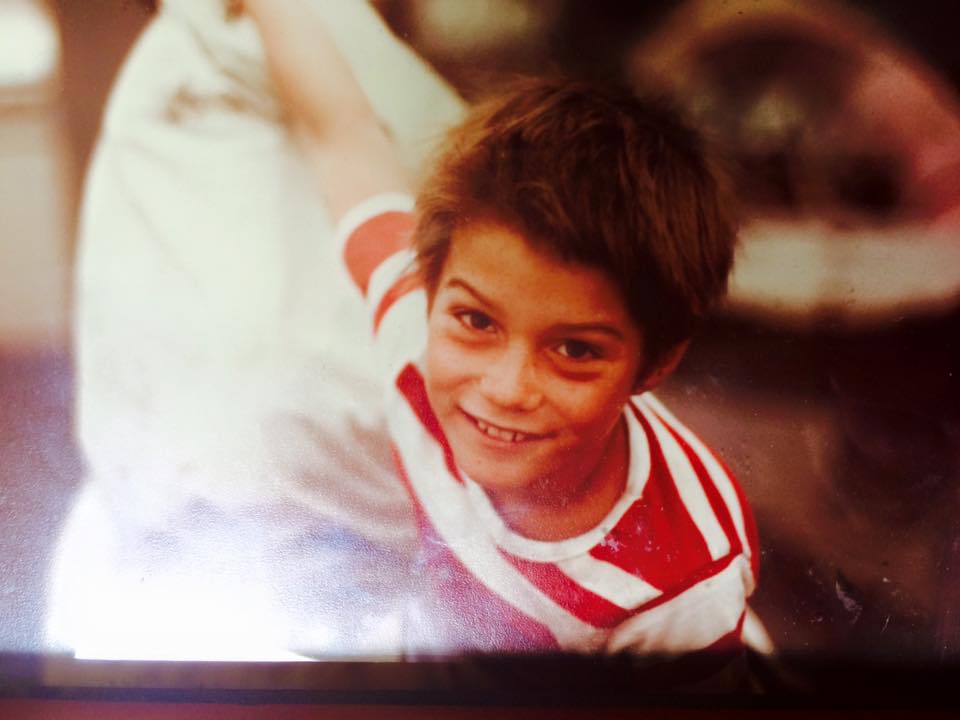
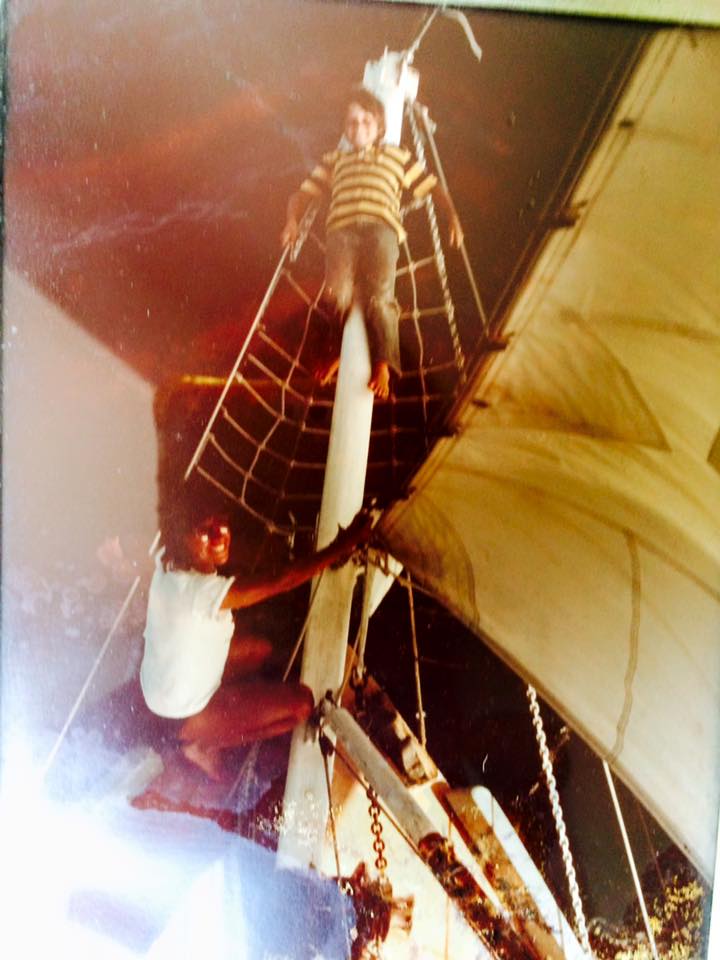
Your son, Bobby, stays out of the limelight. After his dominant debut in the world of MMA, he drew back and became a coach, supporting cage fighters that will be remembered in the pages of history, including undisputed UFC champion, Khabib Nurmagomedov. Bobby’s legacy gives credence to the philosophies of eastern martial arts. I wonder about his childhood, and I try to picture you two training together. Who is his mother, I wonder, and where is she now? You mention that you had lived on a sailboat with Bobby, and the idea sparks my imagination. Your way of life was so off the beaten path that it inspires me to question my own goals and assumptions. I don’t want to idealize you; I know things must have been hard for you, too, but I believe you have lessons for me. Since you are gone now, and I haven’t seen you in many years, your influence must now percolate up from my subconscious: I borrow from you, at times, a slight shift in perspective.
You often stop at the health food store where I work and buy a single carrot and a sesame honey bar (halva). I love that you take time to stop for these simple pleasures, want nothing more, and you never seem to be in a hurry. You don’t have too many things and without materialism weighing you down, your life seems rich. Things, I think, are heavy on the heart and distract us from what matters. Does your example help ignite this realization, one that I’ve forgotten so many times? Oft forgotten like another teaching you tried to impart on me: to find the ying to my yang. While that lesson sounds cliche, and I don’t exactly remember what you told me, what I understood is that my temperament is fiery and I burn myself. I would exist more fluidly by settling my mind, by finding my balance. This is a simple way to describe myriad complexities.
I love to hear you talk about Bruce Lee, who you once sparred with. You trained with a disciple of his own master, Ip Man, a grandmaster of Wing Chun Kung Fu, a style characterized by quick strikes that come from the heart and return just as quickly. A woman’s style. You recall that under your pressure, Master Lee transitioned from his new Jeet Kune Do style back to Wing Chun, but that one of his strikes found your center and changed your body forever. You call Bruce Lee a young master because he burned brightly and then his flame extinguished; then you call yourself an old master, and your face is lit with smile that is both lighthearted and proud at the same time.
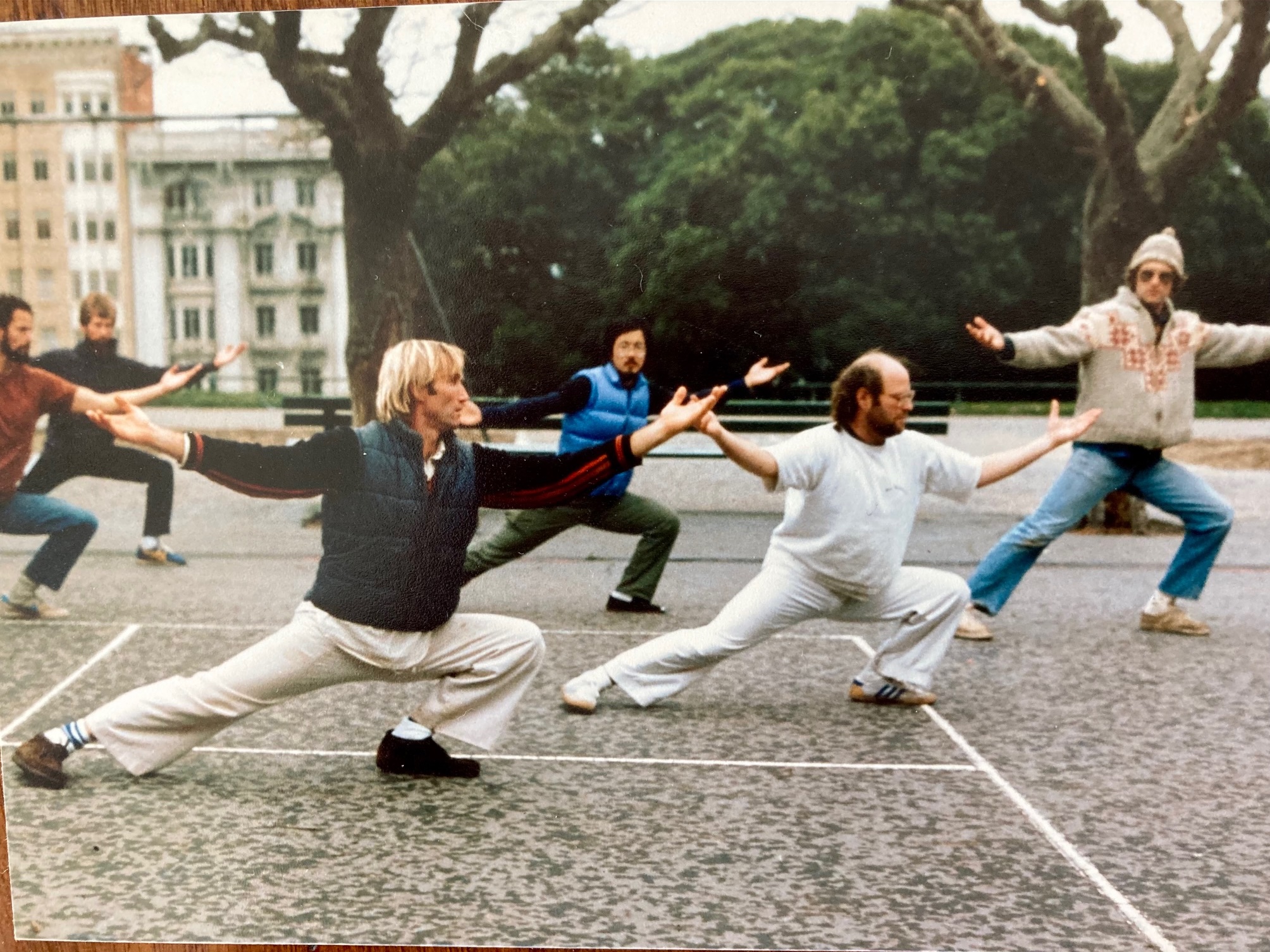
Sifu, you trained with many masters whose names I don’t know. You learned many styles of Kung Fu, of Tai Chi, and Karate, you also studied other disciplines of eastern medicine. I heard that you treated a paraplegic with acupuncture, allowing him to walk again. This story is incredible to believe and I hope it is true because it makes this world brighter somehow. But there is no doubt that you changed the lives of many. Countless people were inspired by your discipline or found solace in sharing your martial arts practice. These are people from the community where I grew up and many, many others from your past that is shrouded by mystery.
Sifu Cook, for me you were singular, and while you have moved on, I hope that your ways are never gone or forgotten.
A story about a severe mountain sports injury and an outpouring of support from my community in the aftermath.
BANG! The sharp sound of mechanical failure strikes the mountain air and reverberates through my consciousness. Ohhhh….shit.
Just minutes ago, I’m taking my first lift-access turns of the season. Just minutes ago I’m bailing on my friends to catch the early morning powder before it gets blown out. Just minutes ago, I’m reminding myself to keep things chill. Now, I cut through the powder as I carve down North Bowl. A sharp rock halts my left ski. I’m pushing hard through the turn and momentum carries me forward but my ski does not move. My leg shatters underneath me.
I’m catching myself on my right ski. Already, adrenaline surges though my veins. I feel deja-vu, like I had some premonition of this happening. Maybe I did, or maybe it’s the cocktail of hormones that immediately dominate my psyche, skewing my perception of reality. I sit down against the upslope and triage my situation. Deep down, I know I’m hurt–and badly–but I can’t accept it yet. I’m still questioning if it’s me that’s damaged or my gear. I reach down and place my hand on my left shin and I feel the sharp edge of bone pressing against my palm. There’s no question now. I breathe in deeply and out slowly.
I nearby skier asks if I’m OK. “No,” I calmly reply, “I broke the f**k out of my leg.” He heads to the bottom for help, but not before mentioning something about North Bowl. That’s great because I didn’t actually know the name of the run I was on. I appreciate the heck out of this guy getting me help but I have cell service so I call ski patrol dispatch on my phone to expedite things. As I wait, my mind shifts towards existential thoughts: I think about my guitar at home; I’m not certain I’ll be able to fully recover from this one, and I think that I can find joy in more sedentary hobbies if it comes to that. I wave my arms at people up on a catwalk above me and shout, “I could use some help down here.” They’re probably confused why I’m yelling and they don’t come, but it’s okay because I know ski patrol is coming. And, happily, they’re here in just a few minutes.
I think it’s a patroller named John that gets to me first. We wait for the toboggan and helpful bystanders stamp out a platform to park it on. I chat with everyone and continue to regulate my breath. “How long have you practiced Zen meditation?” John asks me. He catches me off guard and all I can manage is a quick, wry grin. I might be in shock but I’m working hard to manage my situation with intention and a positive attitude, his kind words recognizing my efforts do so much for me. As we take off my ski together, my boot and the foot inside it wiggle freely but my upper leg does not move. There’s no tensile connection between my upper and lower leg: it’s jello.
I raise my thigh up by grabbing a handful of ski bib and pulling up while the patrollers gently guide my knee and lower leg into a temporary splint before they help me scoot into the toboggan. They bundle me up and we head down. An ambulance is already on the way. Part of me really hopes that we’re going to fly down the mountain; I guess I haven’t let go of my pow day dream just yet.
At the base area, they give me this hot air blower that I get to shove down my sweater, and it feels amazing. I ask for hot tea, wouldn’t that be nice? But I’m not allowed to eat or drink. We’re going to get some pain killers going before trying to take my boot off. In the mean time, they heat my boot with a blow dryer, softening the plastic to make it slide off easily. A patroller named Jason seems to be in charge, and he promises to look into a season pass refund since it’s only opening weekend. My barriers are down, and the partollers’ skill in handling my situation with well practiced professionalism but also compassion is forming a lasting impression.
An IV drip of fentanyl courses through my veins, its effect is like I’ve been walking through a shrouded forest and I suddenly step into a clearing, sun striking my face. The patrollers carefully pull my boot off and I utter a growl more to brace myself then out of pain. “Keep going,” I urge them on. I leave in the ambulance and the trip is not too far.
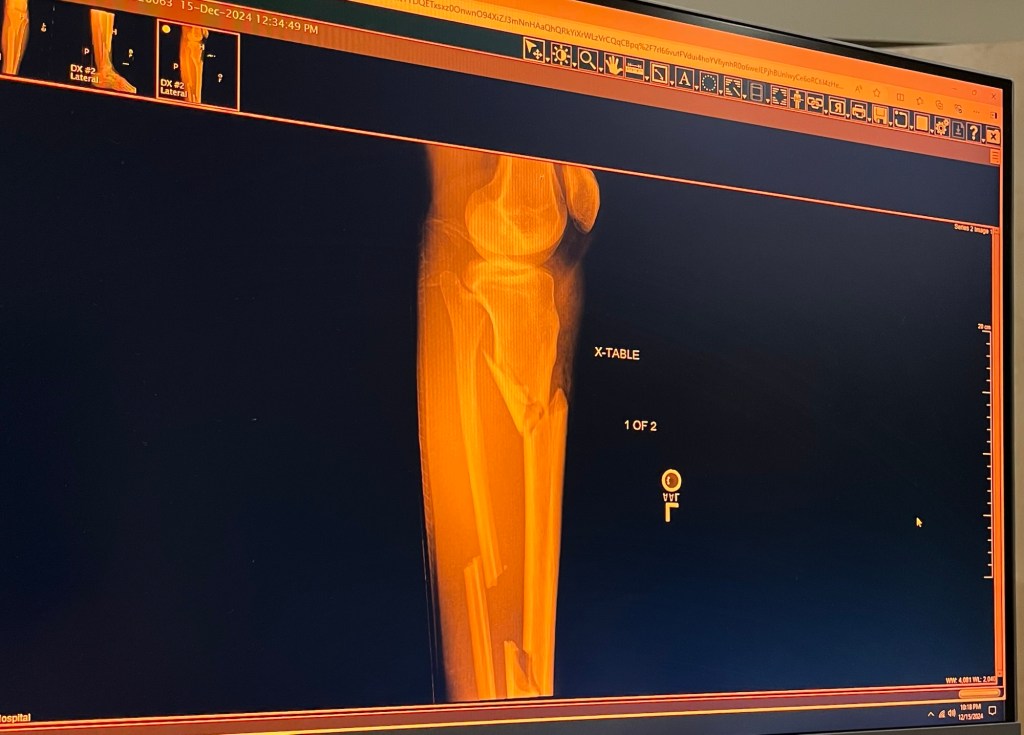
In the ER, A spectrum of healthcare professionals circulates by my gurney. I decide I’d rather talk them through how I want them to move my body and that’s making things a lot better. The X-ray techs snap pictures of my leg. I say that I don’t want to see the images, but I’m lying to myself and I sneak a peak. I chuckle at the sight of my broken tibia and fibula (although I didn’t spot the lower tibial break at that time). The X-rays match my experience: I got totally rocked. Between things, I make necessary phone calls and even get a little bit of work done. Dr. Compton comes in and introduces herself. I’m going to surgery at 4 pm–that’s just a couple hours away. I want my friends Cam and Paige to stop by and say hi. I want their positive vibes before I submit myself to the surgeon’s blade, drill, and hammer.
Cam and Paige make it in time, then I get prepped. The catheter insertion might just be my least favorite part of the day. The anesthesiologist stops by and she’s perfect for the job: a bright and reassuring soul. Then, a nurse comes to take me to the operation, “you know why I’m here,” she says with dry humor. “Why is that so funny,” I wonder, “is it the drugs?” I barely remember helping to move myself onto the operating table and then…I’m regaining consciousness: four hours have passed and the operation is done. A nurse is calling my Dad. It was a nasty break, but the surgeons are pleased with their work. It turns out that Dr. Gelbke, who specializes in complicated breaks, came down from Big Sky to work together with Dr. Compton.
I kid around with everyone that’s there as I return to my senses, I’m in a good mood about the positive assessment and the substantial titanium hardware they’ve installed. I’m a cyborg now. Gratitude washes over me in appreciation for these people that dropped everything on their Sunday to rebuild my body. I’m seeing them in a new light: I’d never thought too much about what motivates high-paid healthcare workers but they clearly care about a lot more than money. In this moment, they’re altering the course of my life by keeping me from becoming disabled, and they’re doing it when most people around here are relaxing at home with their families.
Days later, I return to my condo with the help of my friends and coworkers. I keep thinking about that saying: “you learn who your true friends are by who’s still there when you’re down.” I discover that I have better friends than I ever could have hoped, and their kindness and contributions deserve a much, much longer narrative than I’m giving here.
This is not a blithe take on injury. My leg is severely broken. My body saps my energy to heal itself and everyday tasks challenge my willpower. I wake up at night in pain, often drenched in sweat. Recovery will be long and difficult at best. But that’s just what I’ve got on my hands now and, on the bright side, I’ve come to perceive a heartwarming benevolence in the people forming my community that I hope to never forget.
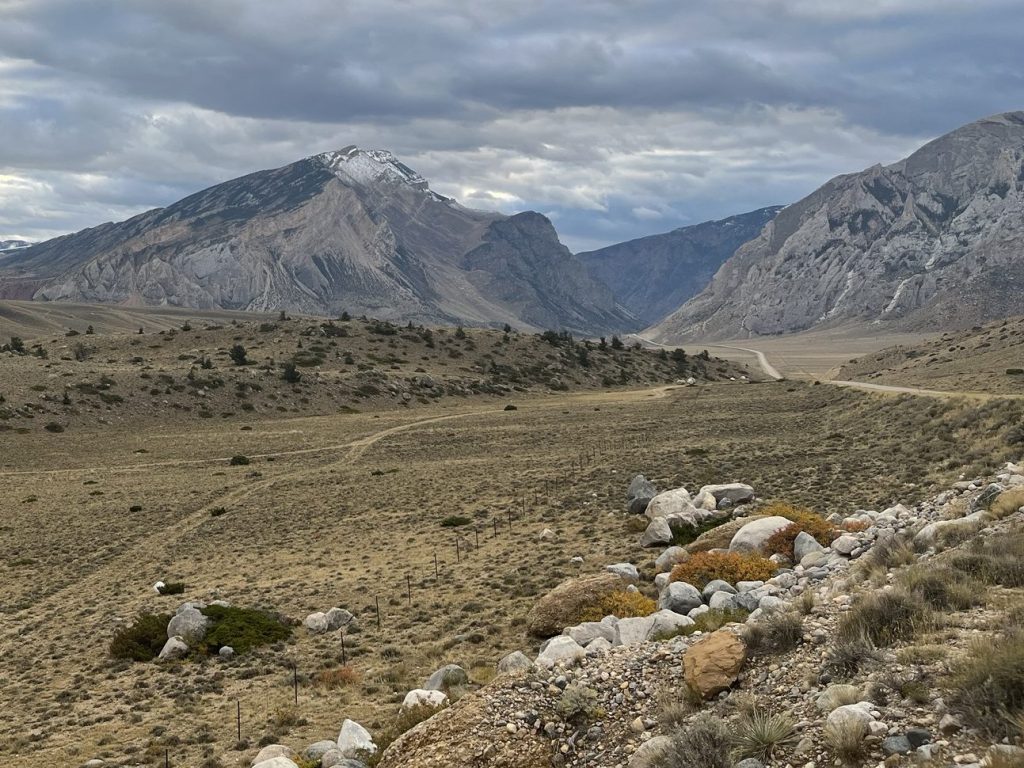
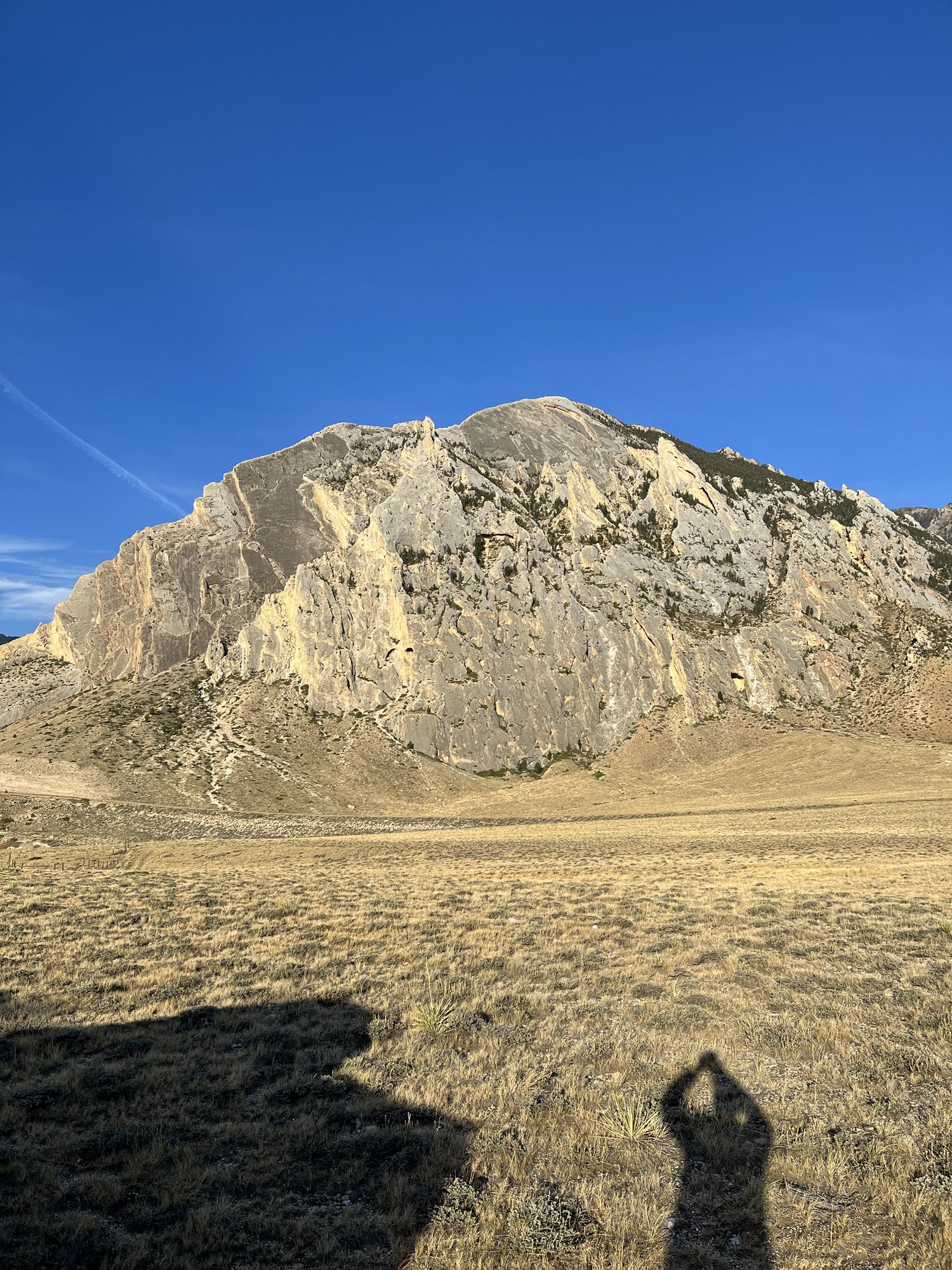
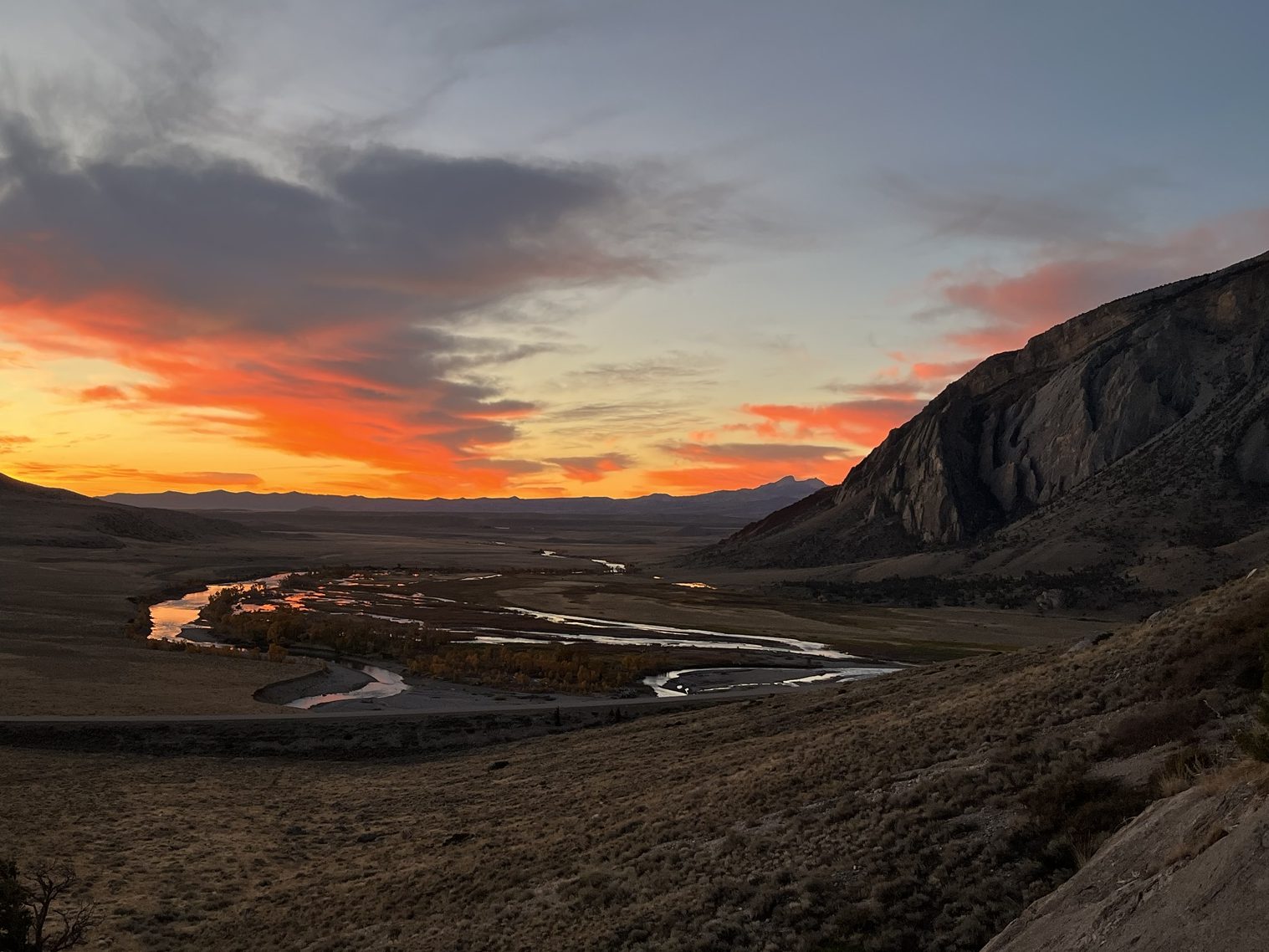
Far off the beaten track of the American west, a limestone uplift soars far above the plains. Like a sentinel, it guards the entrance to a mysterious canyon that cuts deep into Wyoming’s Beartooth mountains. 150 years ago, Chief Joseph of the Nez Perce led his people away from the US Cavalry up this passage as part of a sixteen hundred mile retreat away from impossible conflict.
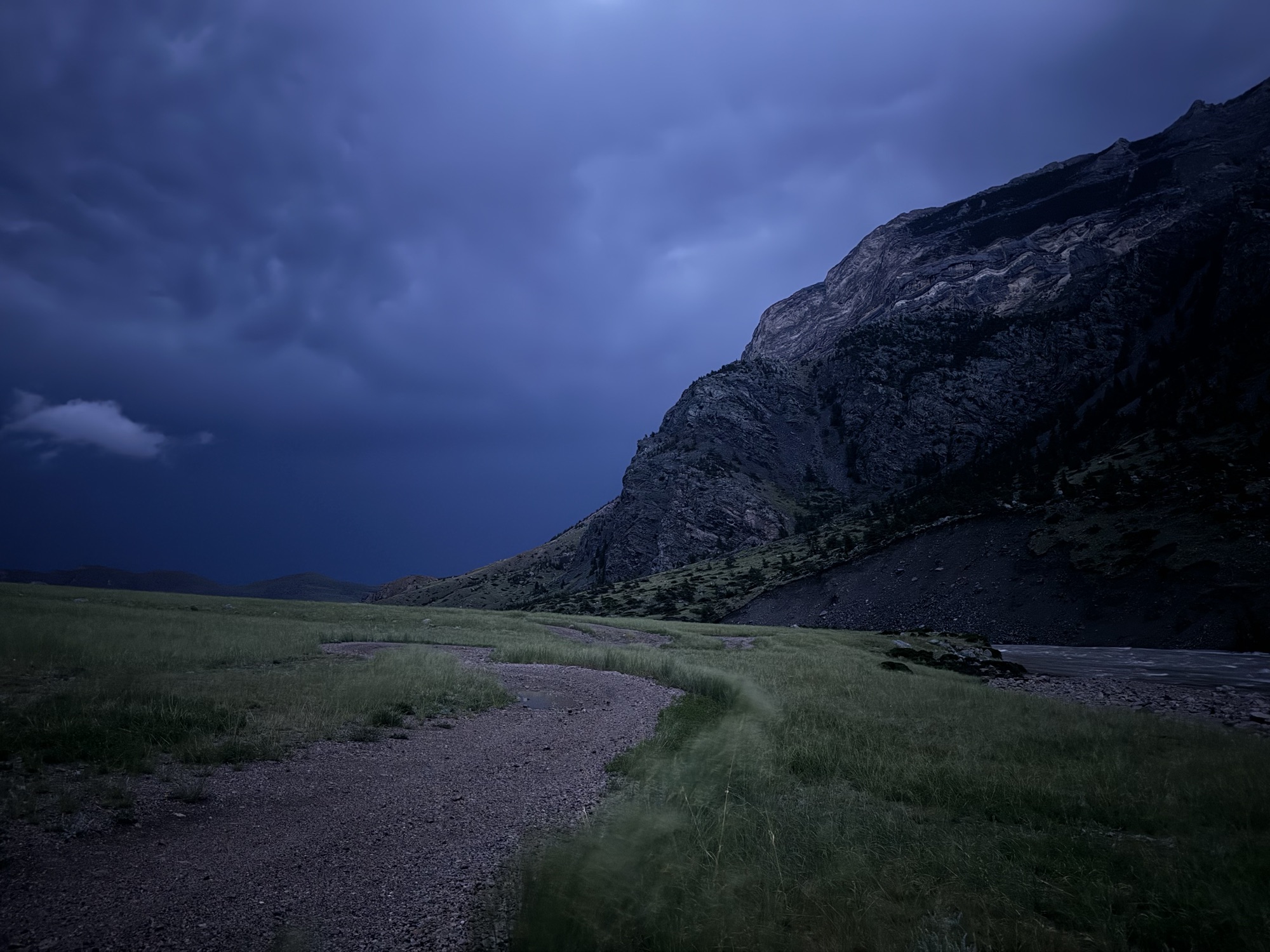
The terrain here is rugged and beautiful. The landscape can be seen shifting: rocks are heard falling down the corroding riverbank at night and turbid spring runoff creates a treacherous but exhilarating stretch of unpredictable rapids. The mountain air is fresh and sweet.
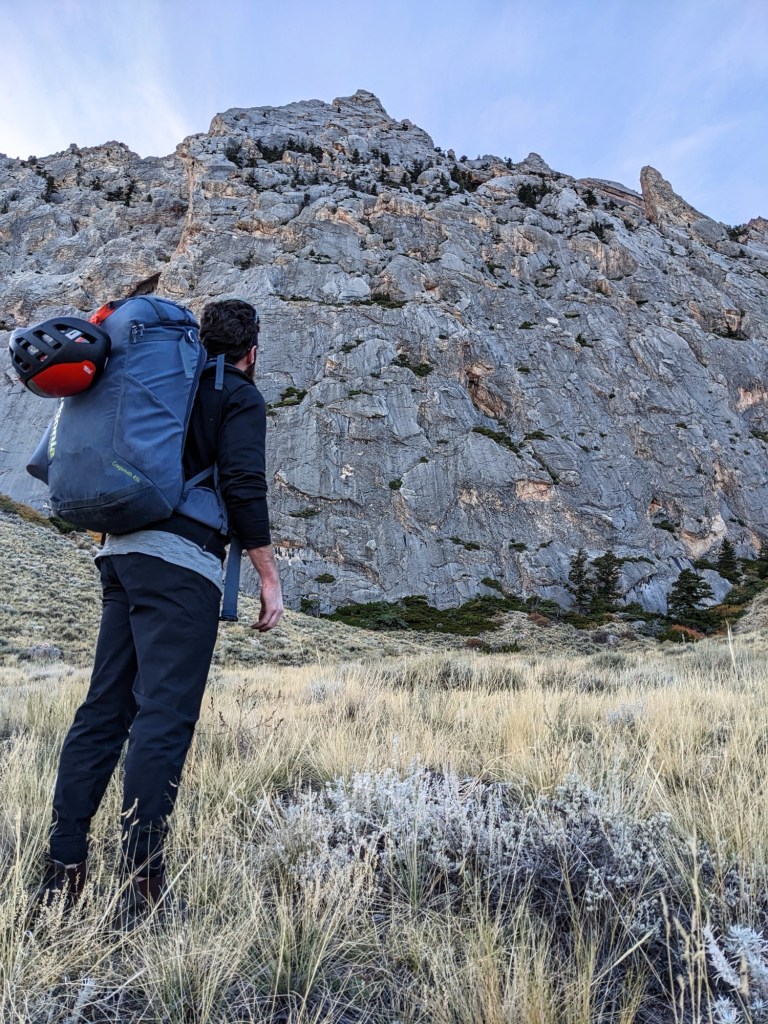
Up the canyon, unthinkably difficult trad climbing routes were set years ago. There is no road access, and a lone 4×4 trail was washed away when an entire section of river bank fell into the water. Lack of access, ruggedness, and remoteness combine to make it so that one only comes here with intention. My intention was to abandon my comfort zone on the ground at the base of the limestone sentinel and to quest up the formation, following a recently-established twenty-two pitch sport route, “M11”—one of the longer bolted routes in North America. During separate attempts on the summit, I would be accompanied by one of two stalwart adventure companions: Allex McDaniel and Mike Thorpe.
The lead-up to M11 was a quickly escalating series of climbs. To date, I had only experienced a handful of multipitch routes, all with soft grades. My best friend, Allex, maybe even fewer. But he’s a notorious instigator, and during the fall of 2023, when we found ourselves briefly living only half a state away from each other (I was in Bozeman and he was camping out near the Big Horns for work), we unintentionally dedicated the rest of the season to getting adventurous with our climbing.
The start was painfully bad. On our first weekend out, Allex and I failed to find the route we wanted to get on, so we settled for a cold beer. That was great but not really what we were after. Then, we started making up for lost time. The following weekend, we climbed a 3-pitch 5.10 and an 8-pitch 5.7. With those routes under our belt, progression seemed natural. Allex texted me about this route called M11 somewhere north of Cody and south of Red Lodge. M11 is 22 pitches long with a 5.11c crux.
At first, I thought Allex was crazy and I laughed off his proposition. 5.11c is as hard a grade as I’d ever sent (although I’d onsighted it) and 22 pitches was mind boggling at the time. Over the next few hours, I let the idea bounce around my mind and a seedling of desire sprung in my consciousness. I had to know if we could do it, I had to experience this new adventure.
Allex and I approached M11 from opposite directions. A winter storm preceded our weekend trip and we were gripped by uncertainty. Would the early snow gracing the high country make for wet, impassable rock? Was this too much much to bite off, too soon as new multi-pitch climbers? But when I captured my first glimpse of the formation, I was overcome with stoke. I texted Allex full of anticipation, something like, “it looks good man!” but probably more, “f*** yah dude!!!” my messages were sent alongside a picture of the monolithic uplift that sent chills down my spine.
Camping near by, we racked up: quickdraws, slings, extra belay devices…gummy bears and sandwiches. Then I crawled into the back of my truck to sleep–well to try to, anyhow. I felt the cold steel of the truck bed through insufficient padding. A chilly current of night time air rustled down the canyon.
Dawn came too early like usual. Since I’m a reluctant morning eater, I choked down the instant oatmeal Allex had brought, trying to hide my ambivalence and show some gratitude. The hot coffee he offered, on the other had, was cherished like an elixir of life. Finishing breakfast, we knocked out the short approach, found the bottom of the route and got on the rock. It was an instant sand bag.
We executed the 5.10 labeled 5.9 and reached the first belay stance. At this point, Allex climbed off route and up a chossy face high above his protection. That’s when we agreed to spot the next bolt line before making moves. He hung a sling on a questionable block for protection and carefully picked his way back down this sketchy bit. I watched his moves in silent concern–don’t fall, Allex.
It was getting clear that we wouldn’t be able to summit but we gave it our all to find our high point. The route oscillated between excellent climbing up vertical faces with pinches, crimps, ledges, and slots, and then it would follow low-angle laybacks along seams running hundreds of feet. You could flow up these stretches and then suddenly be halted by a cryptic section of slab. The belay stances were comfortable, the mixture of grades made for fast travel, and it was magical linking pitches together: nearly 350′ could be climbed almost continuously. A flow state was achieved. We turned around above the crux and twelve rappels ate through the rest of the day. We regained the ground under darkening skies–we’d need to be more efficient if we tried this route again.
That evening, I reflected on my experience. It was a privilege to be out in this beautiful spot with my adventure pal. Opportunities to hang out over the last few years were few and far between. After college, Allex and I had always lived a long ways away from each other, and recently, following a divorce, Allex had embarked on a long stint of globetrotting. I witnessed his travels through photos posted from far corners of the world–Greece? Brazil? Being able to make weekend plans close to home was unanticipated luxury.
The outdoors always puts things into perspective for me: my daily stressors melt away. The feeling of touching cold stone comforts me. My mind ponders the incomprehensible lineage of the landscape, with the timeline of visible geology dwarfing the entirety of human existence. For a moment, my worldly concerns are put in their place: a flash in the pan.
Take 2
Allex and I didn’t want to be shut down by M11. By climbing the crux we proved to ourselves that we just needed to be faster to make it to the top. Over the next week we plotted together on how could we climb more swiftly, rappel more swiftly, and ultimately bag the summit. I hunch over my phone at night, slogging through debates on mountaineering forums about whether simul-repelling was a good idea or bat-shit crazy. We explored the idea of using a tag line and repelling two pitches at once. I bought a whole spool of static 6 mm to use as a tag line but then my imagination ran wild with nightmare scenarios of the rope getting caught on a jagged feature way above us. This route didn’t seem like a good place for a tag line. Simul-rappelling it was. We agreed to tie ourselves together for safety and make sure to use our third hands (this is very uncomfortable, there is no perfect answer to safety for inherently unsafe endeavors).
I stepped back onto the first pitch of M11 the following Saturday as the morning sun broke the horizon. Looking back down at the maws of the canyon, the braided river trailing into the plains was decorated with golden cottonwoods that would soon catch the pink rays of the rising sun. The scene burned into my mind. For a fleeting moment, I held onto that ephemeral feeling of experiencing something truly special out here.
We swiftly yo-yo’d up the pitches and raced passed our original high point. Low-angle stretches made our toes scream inside our downturned sport climbing shoes as we ran up the formation. when we reached the route-setters bivy, we wandered around for a few minutes before finding the route again only to be rewarded with some seriously sandbagged slab climbing, “5.9 my ass!!” We were making great time and we had to because this late in the year, darkness comes quickly.
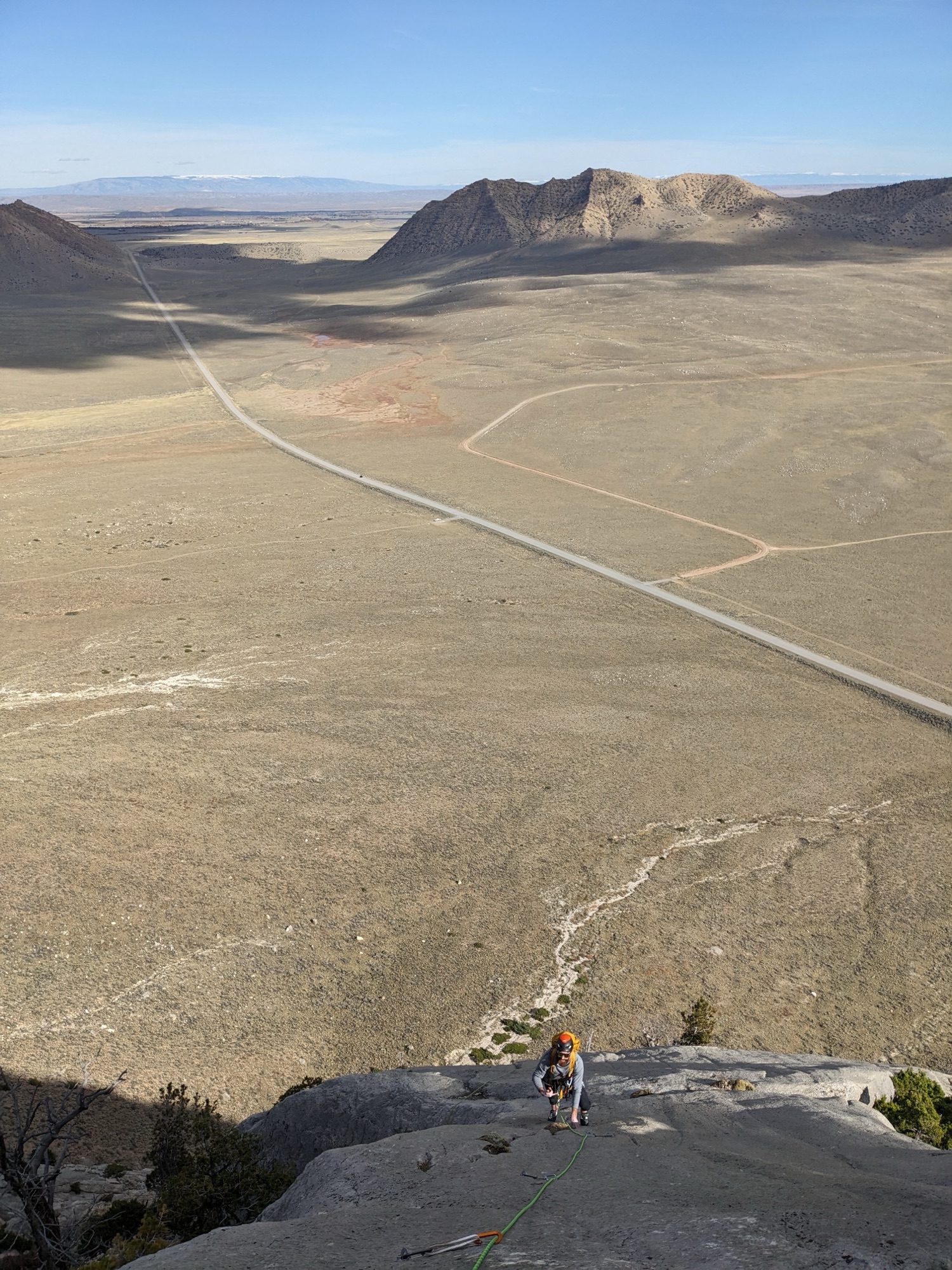
On pitch twenty, the giant limestone flake we scaled had pulled away from the greater mass of the uplift, and it narrowed into a spire above our heads: Chief Joseph’s Horn. I surfed along the arete defining the rightmost edge of the flake. To my side, I felt the void of a great emptiness. The route setters had taken 5.4 climbing as an excuse for massive runouts, and this fact coupled to the exposure made for a delicious and airy experience. With the far bolt spacing, it took extra time to find the next bolt hidden against the fractured rock face. The 5.4 pitch led us to a 5.11- headwall that blocked the summit.
We had made good time, but not good enough–it was 2:30 pm, and we’d agreed to turn around at this point. The top was so close that I could taste it but we had 20 rappels left before our feet were on solid ground. That would take a lot of time, and oh yah, Allex was expecting a baby in just a few weeks. Being safe seemed pretty important right then.
The belay station under the headwall blocking Chief Joseph Horn (top of pitch 20).
Heading down was a total slog. I’d leave it out of this story if it weren’t such an important part of the journey (you ever notice that in mountaineering films they never show the decent even though it’s one of the most dangerous parts?). The raps were so boring but we tried our best to stay on guard. During this time, a good partner has your back: “you want to clip in to the anchor, Asa?” Allex queried as I started to escape the rappel. I guess I was feeling a bit too comfy on this lofty belay ledge. “Oh jeez, yah of course.”
We dialed in our system–we didn’t need to trade words as we threaded the rope through chains, coiled sides, and tossed them down below us. But once we weighted the rope to rappel together, communication became essential. It was kind of hilarious being tied into each other simul repeling, both of us grumpy with exhaustion but unable to get more than a few feet apart for hours and hours. There’s few people I can tolerate in this sort of proximity; fortunately, Allex is one of them.
Finally, there was dirt under our shoes. Fist bumps and a cold beer were in order. Darkness fell as we left the base of cliff and looked back on the crag. We watched a party on a nearby route searching out anchors with headlamps and we didn’t envy them.
Climbing twenty pitches of M11 was a fulfilling way to wrap up the climbing season. I felt accomplished, but I lacked closure. I knew I could finish the route but I didn’t know if I ever would. Would this be the one that got away? Allex had to leave the States. He returned to Germany for the birth of his son and just like that, my climbing partner had come and gone.
Take 3
If I ever got back to M11, I had to climb 20 pitches all over again just to get to my previous high point. But this barrier was less than the challenge of finding a good climbing parter. That was the true missing link. I needed someone that I could trust with my life 1,000 off the deck and someone that had grit, skill, and motivation.
My friend, Mike Thorpe, fits the profile of just such a climbing parter, so you could say I was pretty stoked the following June when he asked me to go back out to M11 and climb it with him. Maybe my tales of the route and the mystical canyon behind it had their desired effect. We agreed to make time in our busy schedules for this to happen. Two weeks later, we drove back down to Wyoming.
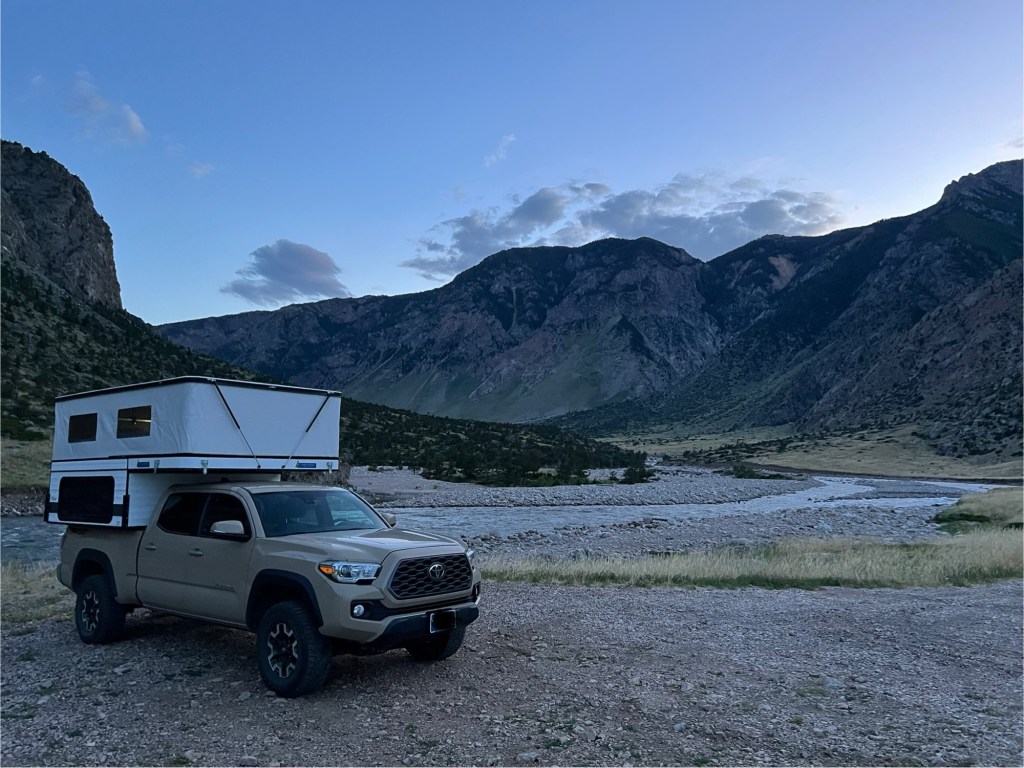
We reached camp as the sun was receding behind the canyon walls. I stepped out of the truck into the tall grass on the river bank and a thick cloud of mosquitos set upon me. I wasn’t upset, I like how wild this place is. Then, scanning our majestic surroundings, I spotted a group of large, fury brown animals headed down the canyon towards us before disappearing behind a hill. In the failing light, I couldn’t see if they were cows….or grizzly bears. I wished for binocs badly. Before I lost sight of them, their gait had seemed to me both powerful and casual, like an apex predator. Mike and I made contingency plans and resigned ourselves to our fates whatever they may be. Thank god we had Mike’s truck bed camper for shelter, from the mosquitos anyways. For the suspect griz, the shelter felt more like a pantry ladened with morsels–us.
But the night passed uneventfully, we awoke to good weather and had a relatively casual morning. The long days of summer meant more time to climb. Leaving the ground at the base of M11 for the third time elicited a sweet sigh of relief from me as we left the mosquitos far below. We moved efficiently but we didn’t rush, we had to pace ourselves. As I inspected my bright green rope that I had bought last fall, I observed thousands of fuzzy green hairs sticking randomly out of the casing, caused by abrasion from the sharp textured surface of this limestone behemoth whose embrace I welcomed once more. The rope still had a lot of life but it was sure showing wear from this route. I felt the same way–strong but worn. This would be my last burn on M11 for the foreseeable future.
Mike and I climbed valiantly. I thoroughly enjoyed the same pitches from before that had excellent movement. I wanted badly to climb the pitches clean, but I blew a foot on sandbagged slab climbing (and later on I would ask for a take). Fortunately, perfection wasn’t the plan, just a preference. Mike got to experience the unexpected characteristics of this route, like holds that had gone missing making for harder grades. He led the thin, pumpy, and enjoyable crux. His feet screamed in agony on the abundant low-angle friction fests. His climbing shoes were almost new and hardly broken in–I bet that sucked.
At the bivy ledge, some 14 pitches off the deck, things were catching up to us. Im not sure what made us more weary: the long work week we came off of, or the climbing. Either way, we took a long rest on this ledge; and after, reveled in the crisp juicy sweetness of apples. I was learning that the body wants sugar in a scenario like this. My other provisions sat heavy and undigested in my stomach, but this fruit just felt right to eat. When it was time, we pushed on, at least partially recovered.
As we tackled the final pitches, for a brief time, Mike’s eyes had a far away look caused by exhaustion. For that time, I doubted our objective. If we had to turn around it would be disappointing but it would be OK, we do this for fun. But Mike has more grit than anyone I know. He shook himself off and I watched him roll his shoulders back and fully embrace the present moment. As he inhabited this new space, his stoke now buoyed me up the wall.
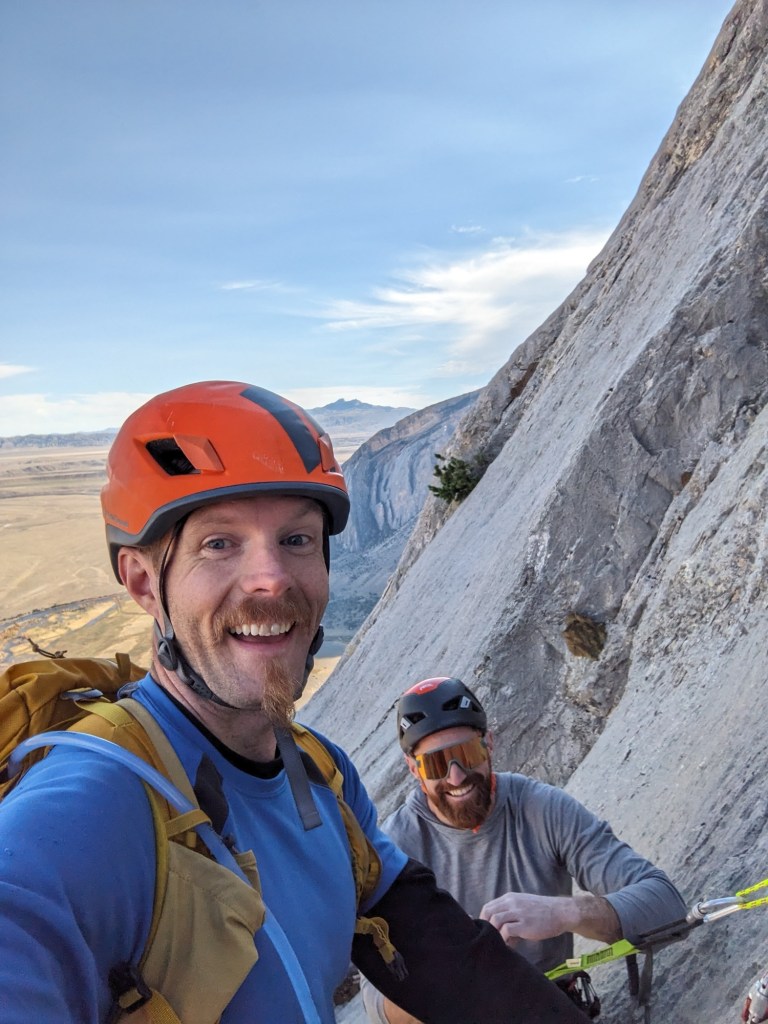
We reached the headwall guarding Chief Joseph’s Horn and I led the last 5.11- pitch. It was an exhilarating sequence this far up in free space. I doubted myself not for my physical ability, but out of fear of making a mistake this far from safety. The climbing was excellent, just thin enough to be spicy, but it was all there. Behind me, Mike tapped into some hidden reservoir of athleticism, no doubt provided by his vast experience in the mountains, and then climbed the headwall with great style. And then, we battled up some chossy low angle blocks and gained the summit. Finally, we had made it. Us two human specs celebrating on this lofty perch, a place thoroughly steeped in geology and history, much of it long forgotten. Behind us, the Beartooths and Central Absarokas erupted into the sky, in front of us stretched the vast expanse of Wyoming. I couldn’t resist sending Allex a picture of us up there.
This was the adventure that taught me that a bucket list vision can become reality. This same adventure was so rich in experience that it sparked a deeper interest in journaling, ultimately leading to this blog. This is a story of friendship and possibility.
Text from Allex, November 30th 2022:
“I’m taking my split board to Germany with me in February so I can do the Haute Route and I need a bro to go with.”
My reply:
“Sounds great!”
“What’s the Haute?”
I agreed to the proposition immediately because I knew that best way to have an adventure is by simply being down to have an adventure, I didn’t need to know what the hell the adventure actually was.. Having already agreed to join, I googled the subject. The Haute Route is a famous passage through the Swiss and Austrian alps between high-altitude mountain huts.
“Damn looks incredible” I added to the text string.
Glaciers and avalanche terrain would be crossed in an unfamiliar mountain range on the other side of the world. Even without asking, it was understood that we would embark on this endeavor without a guiding company which wasn’t really a choice to save money–and it’s not that I had enough mountaineering experience to obviate a guide–it’s just that Allex and I liked running our own show. It’s riskier and more rewarding.
In the following weeks, we discovered that vacancies in the mountain huts we needed to stay in were gone. Not surprising that a two month lead time for a world famous circuit that thousands of people have on their bucket lists was not planning far ahead enough ahead. So Allex and I pivoted to another noteworthy tour: the Silvretta Traverse. Before we had any other bright ideas like checking this route for vacancies, I bought a plane ticket so that we could lock things in.
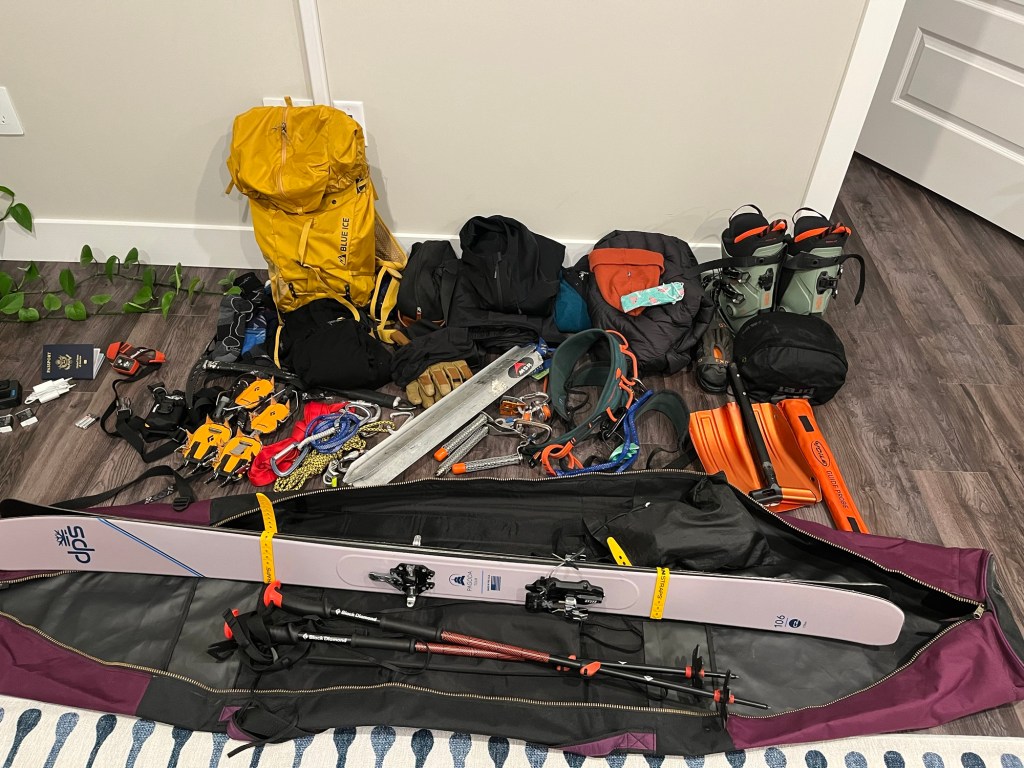
A week or two before departure, we finally started to get our things in order. We scrambled to book spots in the huts (Allex’s girlfriend at the time, and now wife, Tanya–a fluent German speaker from Bulgaria–mercifully pitched in and totally saved our asses communicating with the hut management). To make the trip work out with hut vacancies, we’d have to reverse the standard direction of travel. At the same time as making hospitality arrangements, we learned glacier rescue rope systems and rounded up the necessary gear like ice screws, snow pickets, headlamps, crampons, wool long johns, two pairs of underpants…not nearly enough socks.
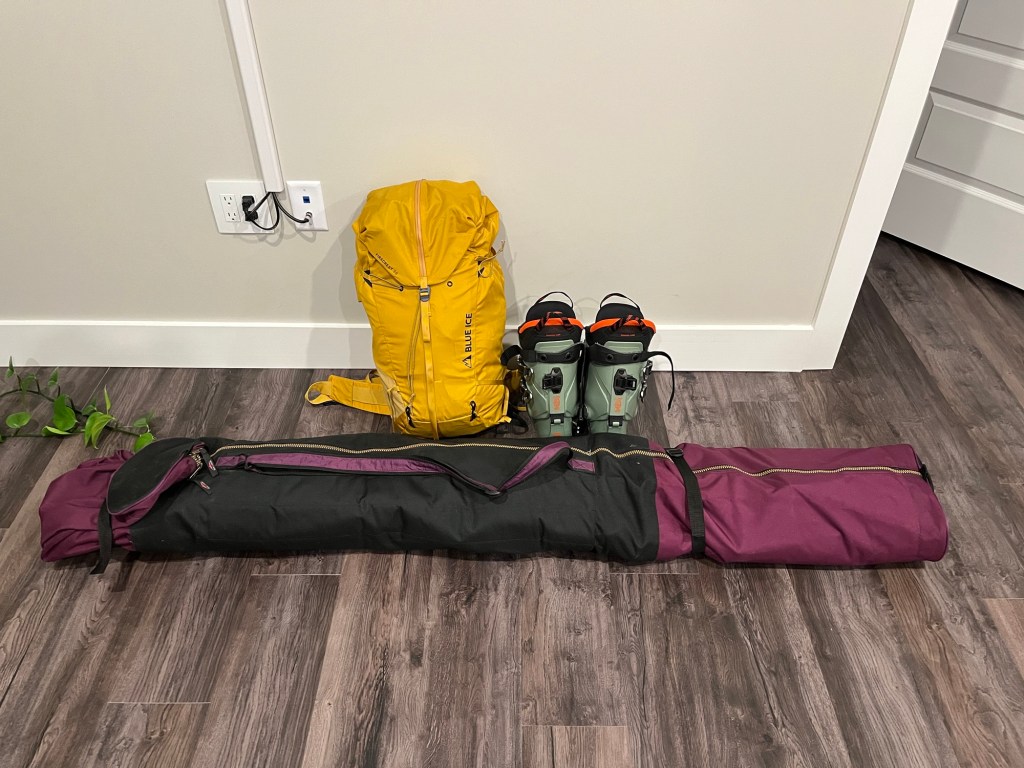
The gear spread before packing.Neatly packed and ready to go! I still can’t believe all this gear fit in such a small space—I didn’t have a backup plan.
Departure day came suddenly and I was off to meet Allex in Munich. The plane flight kicked off a 36 hour stint on the move without sleep, fueled only by stoke.
At Chicago O’hare Airport, I exited security to workout in the central hotel gym thinking I would pass out on the international flight and wake up refreshed in Germany. Instead, I didn’t sleep a wink. When I touched down in Munich, I finally met up with Allex and met Tanya for the first time. I probably made a poor first impression because I was delirious from travel and sleep deprivation.
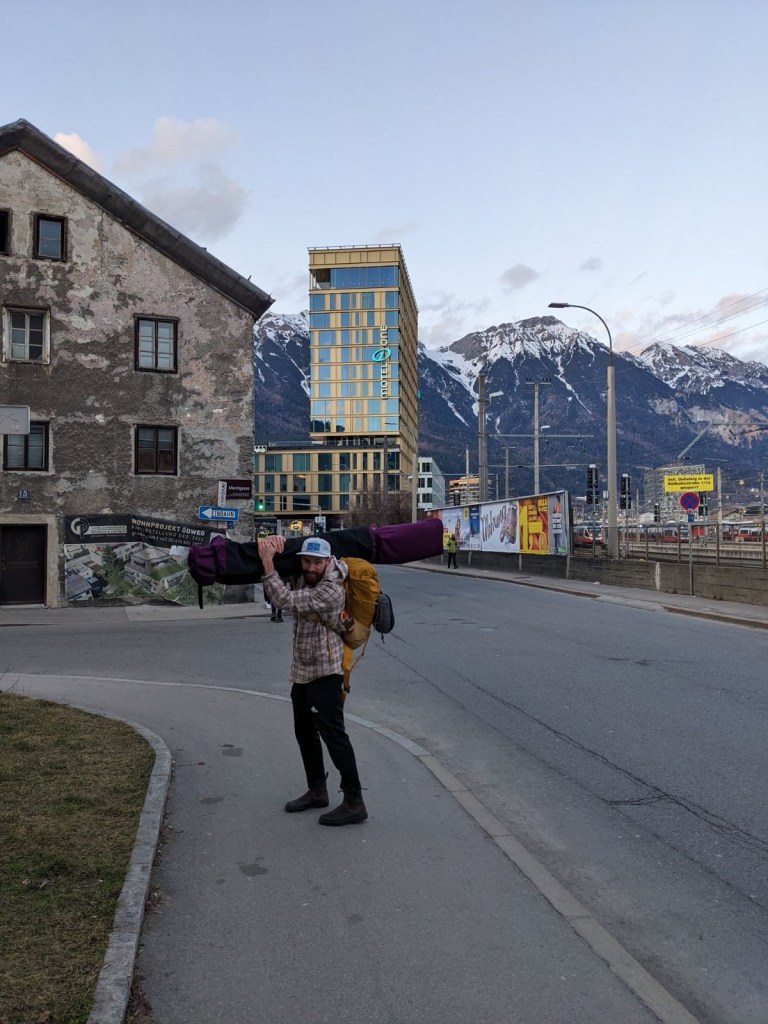
Getting to Europe was only the first leg of the journey that day, which was followed by a blur of memories: failed attempts to pull cash from an ATM, shawarma, saying goodbye to Tanya, a narrowly made bus connection into Austria and surreptitious bribe demands from a bus hand (unofficial tourist taxation), the Alps rising into view from a bus-seat window, Turkish men threatening to fight each other near an Insbruk brothel, a quick stop for a cold beer, getting evicted from first class-class train seats, walking seemingly for miles with 40 lbs of gear on my shoulder and then realizing we had gone the wrong way and having to turn around. Finally, the relief of a bed made for a tiny person that was somehow the comfiest thing I remember ever experiencing.
A ski bag loaded heavily with mountaineering gear was my cross to bear as I schlepped it from one country to another. A bag with wheels would have been great.Austrian continental breakfast was a cut above.
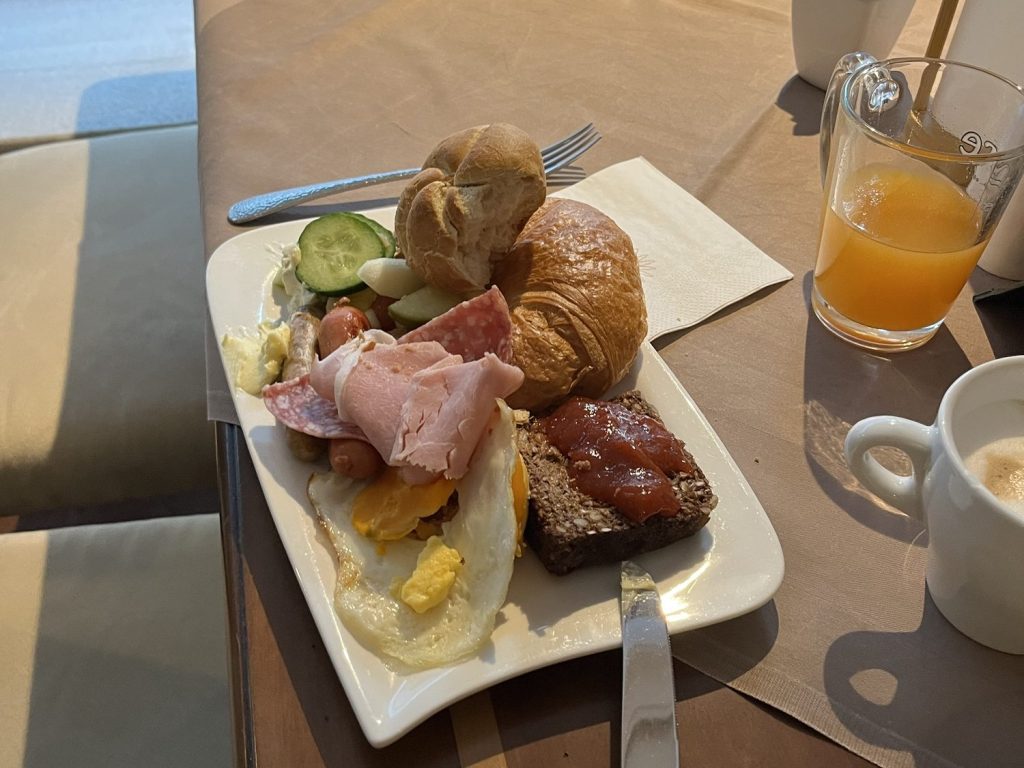
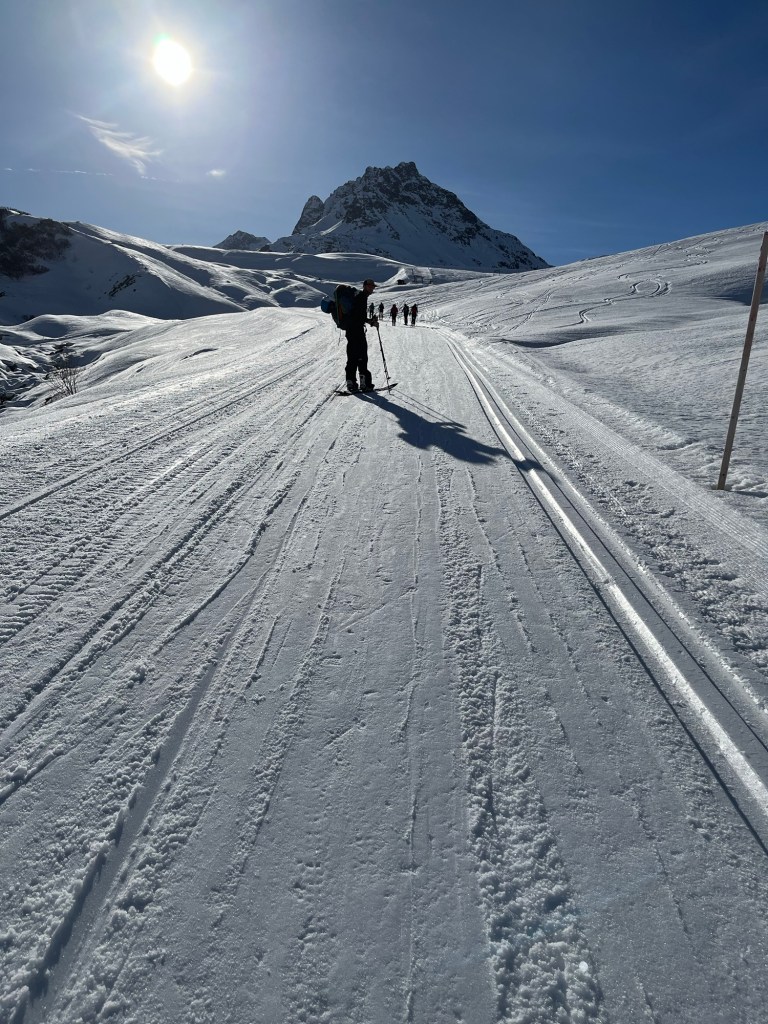
Landeck was a fine town to wake up in. The miniature size of the hotel room was made up for by a hearty breakfast. Our packing had left a bit to be desired and we stocked up on final supplies before catching the bus to Wirl where our trek into deep mountains would begin. The bus navigated a steep and windy road between mountain villages where bright eyed youngsters dressed in ski regalia got on and off. The children were cheerfully familiar with bus driver who seemed affectionate and protective, telling us a the story that a close-knit mountain community exists in the area. We were dropped off where the road made its way up a long valley lined with sheer mountain hillsides. During the winter, cars can go no further as the road isn’t plowed and its snowy covering is groomed into a ski and snowmobile track.
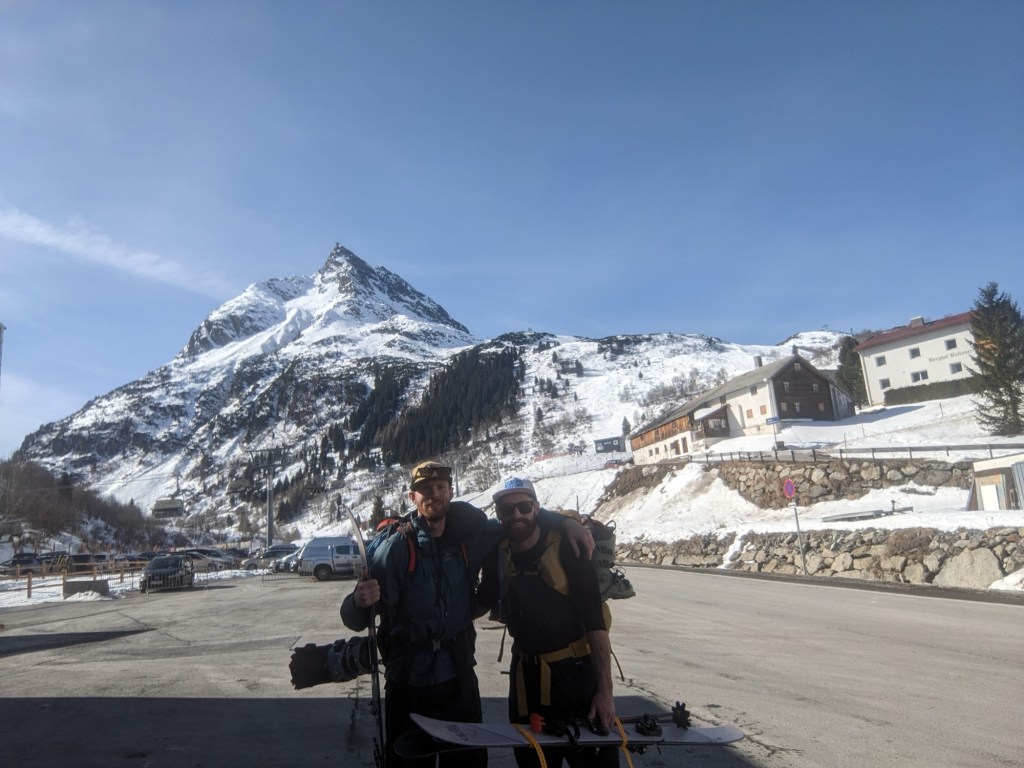
The start of the trek in Wirl. We finally made it! Just getting there was it’s own journey: the planning, the packing, the plane trip and then further travels by bus and train. We were all smiles embarking into the mountains. The thrilling unknown lay ahead.
At this point it’s worth mentioning that I had left a deep snow year in Montana for the worst year anyone can remember in the Alps–isn’t that just how things work? Anyhow, the long period without snow eased fears of venturing onto thin snow bridges concealing deep crevasses in the glaciers that lay ahead.
We pushed off and skinned for miles up the valley. Moleskin came out to ease hot spots developing in our boots and to prevent blisters from forming. The unseasonably warm weather had triggered wet slides all along the valley sides; the landscape was in flux, February felt like May. The warmth put us on edge, but we had yet to discover that we would climb much higher in the mountains into cooler terrain before the day was over. Over the miles, we leapfrogged with a couple from Basque country that were on a similar trek and we exchanged light hearted banter in a smattering of languages. Stopping for a short rest, Allex spotted an Ibex high on a mountain face. We watched for a while, enraptured by this exotic creature.
As the evening approached, we reached Silvretta-Stausee–a lake that sits next to the highpoint of the road we had traveled on. There, we found Silvretta-hause hotel, which was accessible in the winter by cars coming from the other direction and it was therefore well stocked with food and tourists. We were still a long ways from our destination, but Allex and I were already pretty tired and the thought of warm food and a delicious Austrian beer easily lured us up onto the patio.
Austrians are a zesty folk and the waiter was no different, bluntly refusing our attempts to order in English. I awkwardly stumbled through speaking in German, “Ich möchte ein dunkel, Danke schön.” I exclaimed, desperate for a cold beer. His expression softened almost imperceptibly but winkles of amusement appeared at the corners of his eyes. The beer ordering went well, but his impatient demeanor made us hurry through ordering food. I asked for Haus Wúrst, imagining that I couldn’t go wrong with the house standard of a famous germanic food. Allex ordered “SpongeBob.” Immediately I felt that I had blown it. Allex had been in Germany for weeks now, and his girlfriend was basically a native. I suspected that he had secret local’s knowledge of this amazing SpongeBob dish and it was a delicacy that would make me jealous. But when our food arrived it became clear that he had ordered from the kid’s menu: two ungarnished hot dogs sat atop a handfull of french fries. I felt bad enough to share some of my delicious Haus Würst.
We floated the idea of staying at the night here, but I was determined to reach our first hut reservation. I can’t recall if I had one beer or two, but I was definitely tipsy as we launched back onto the skin trail. We skittered around the lake laughing about SpongeBob and sometimes falling over, at risk of sliding down an icy slope onto the broken ice that covered the water. We were all jokes and took a lot of shitty pictures. But sunset fell quickly and the toils of skinning induced sobriety.
We referenced Fat Map repeatedly to get an idea of what lay ahead of us and when we would reach the first hut. Without service it was hard to get our position dialed. Onward we trekked, guided by REI headlamps and fueled by occasional gummy bear breaks. We passed a sign declaring, “Weisbadner Hütte: 3.” I was thrilled! Only 3 more kilometers? But an hour an a half later there was no hut in sight and the arithmetic just wasn’t adding up. Surely we traveled at least 3 kilometers per hour: surely we should be there. That’s when Allex realized that the signs were written in hours of travel and not distance!
The final approach to the hut was up a long, steep slope. Darkness and a disorienting nighttime mountain landscape altered depth perception. Time passed slowly as the lights far above us slowly materialized into a building. We found the ski room and then ventured inside, searching for and finding the grumpy Austrian host. I was nervous to interact due to exhaustion and language barriers but there was nothing for it. Despite the host’s poor manners; he seated us next to many fellow adventurers who were enthusiastically downing goblets of wine, and he did is job admirably: despite our late arrival, he brought us a multiple course meal consisting of steaming hot soup and large portions of schweineschnitzeland that we downed hungrily. I have few other memories of the day, except that several euros bought me about 20 seconds of hot water for a shower. Once we reached our bunk beds, sleep came quickly.
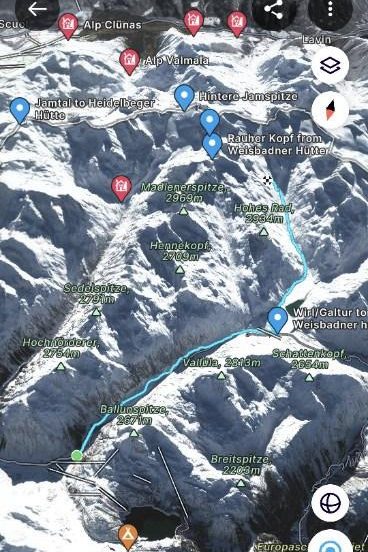
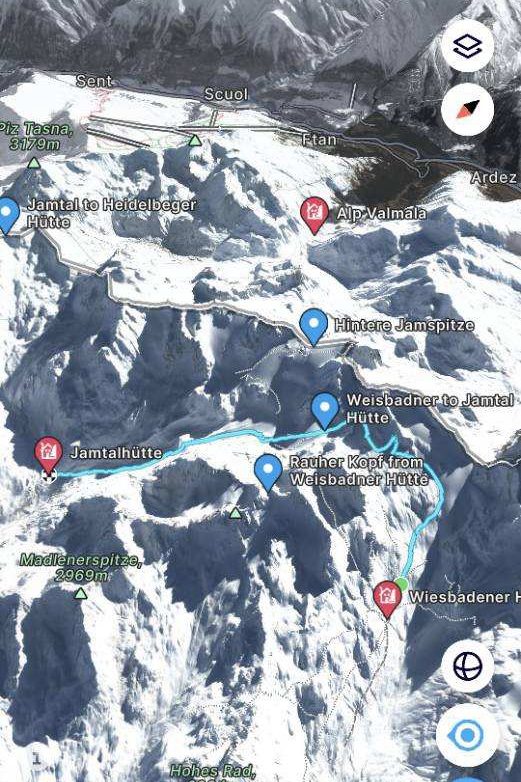
The route on day one: from Wirl to Weisbadner Hütte.
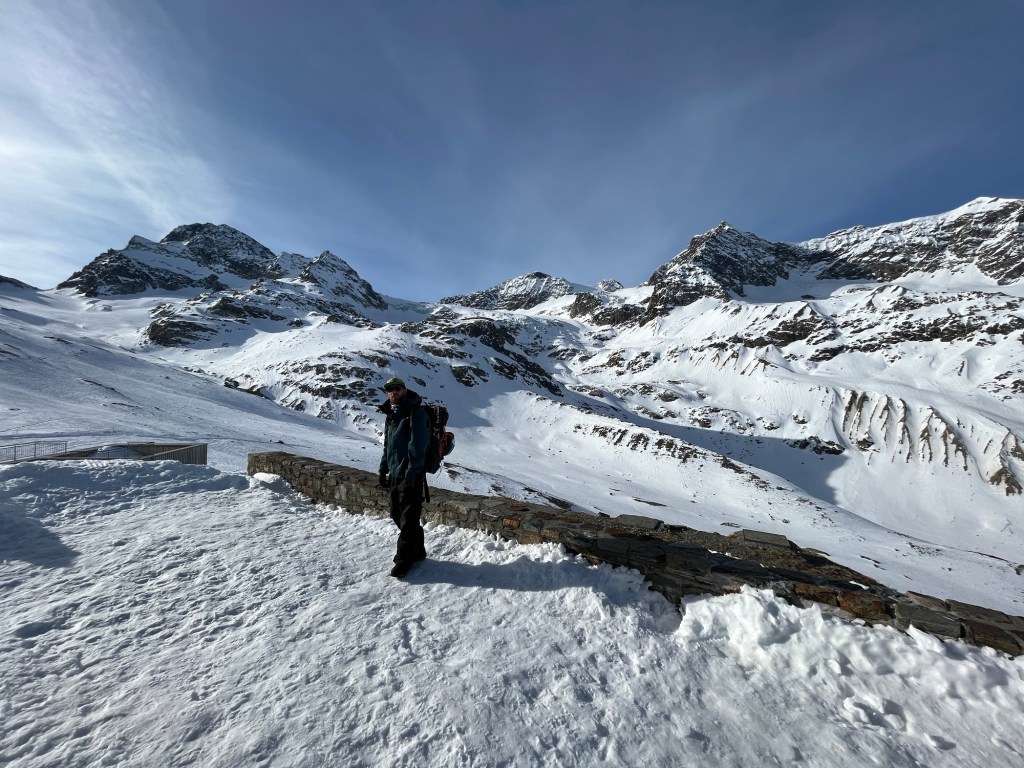
The following dawn yielded a clear vista of the marvelous terrain we had entered under the cover of darkness. Across the valley, a turquoise glacier hung on the side of Piz Buin, one of the many rock-crested peaks that enshrined the horizon. Piz Buin looms at 3312 m, one of the highest summits in the area and todays destination for many fellow trekkers. In fact, we could see skiers making their way up the approach. Having started early in the morning, they were far away and nearly imperceptible against the bulk of the mountain. Allex and I wanted to recover from the previous day and chose an easier side trip in the opposite direction.
Allex on the patio of Weisbadner Hütte. The mass of Piz Buin (center right) lies in the background. For scale, many skiers are in the background making their way up the snow fields but you can’t even make them out in this picture.
We filled up on the breakfast fare that I learned is standard throughout the huts: muesli, yogurt, toast, jams and butter, thin sliced cheeses and cold cuts. Although breakfast was laid out for us, we had to ask for multiple small carafes of coffee before we had our fill. It’s unlikely to be a best practice, but several trekkers took additional provisions from the breakfast table for their lunch. Allex and I were already stocked up with summer sausages, cheese, candy, and other energy-dense foods.
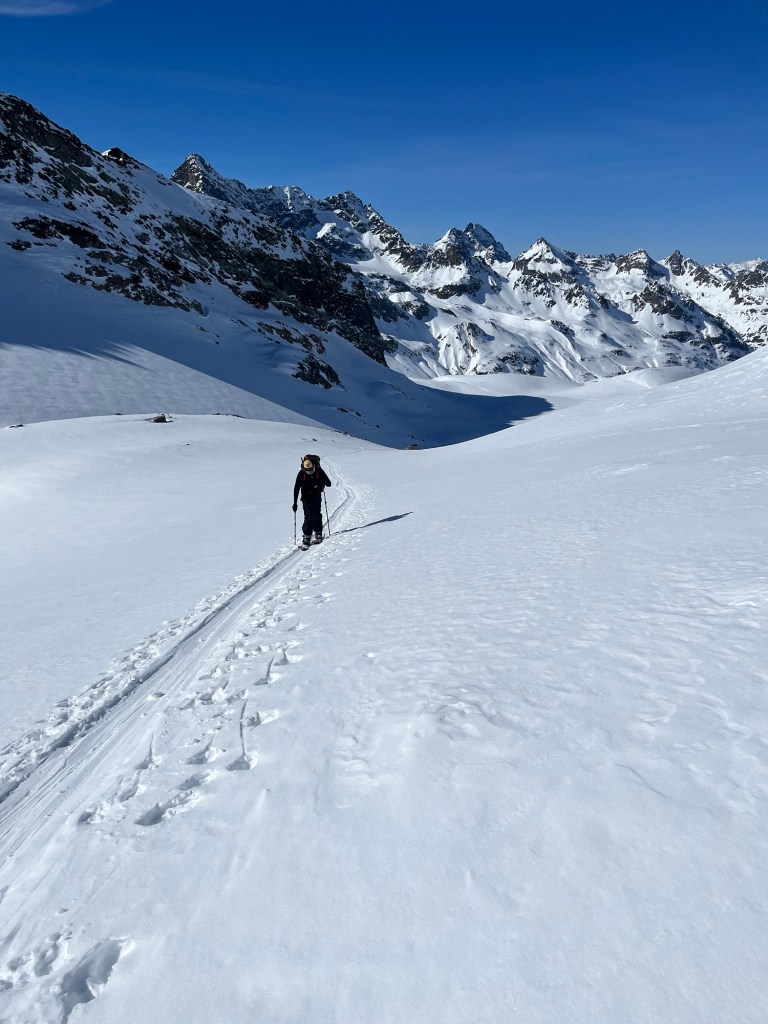
Immediately following our departure from the hut, we cut our way up a steep south-facing slope. Freeze-thaw cycles had turned it to icy hard pack. Allex installed binding crampons to keep himself from sliding backwards or down the slope in an uncontrolled tumble onto rock fields. I relied on upper body strength to stab my ski poles into the crust and I used my poles to wrestle my way up the hillside. Ski crampons and a whippet seem prudent in retrospect, but with this being my first major ski tour, I lacked the experience to know this in advance. At one point I slid back more than I advanced. There was so little hope of skinning up further that I pulled my skis off and boot packed the rest of the way up the pitch.
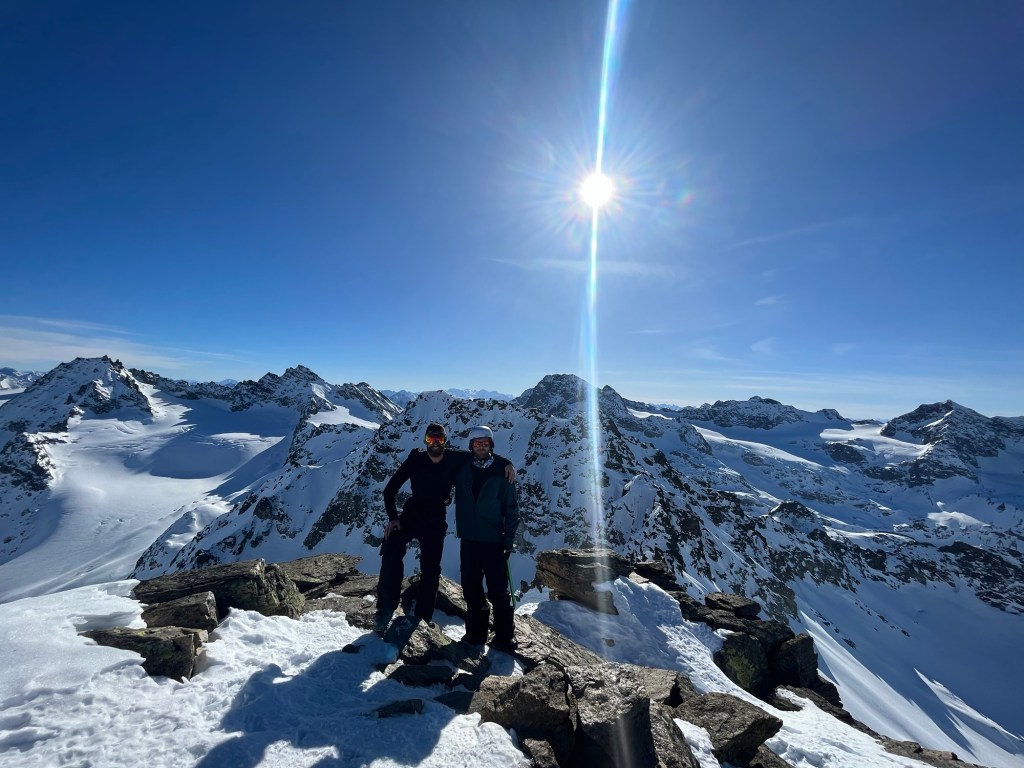
The initial climb brought us to a rolling, low angle path up a cirque enclosed by rocky chutes. We marauded forth for several miles until we gained the final approach to mount Rauher Kopf and the angle surged dramatically. We battled our way up more icy switchbacks to a saddle where I left my skis and Allex left his split-board so that we could climb our way up the rocky summit by foot. My hard plastic ski boots were slippery on the rock surfaces and the protruding toe piece made it difficult to climb in the way I was used to. These unexpected conditions caused me to tense my body and I gripped handholds forcefully as I climbed. At the top of the mountain we found a steel cross, a foreign object to find high in the mountains; another reminder that we were far from home. For the first time, we had a 360 degree view of our surroundings. Exhilaration punctured through our labored breathing.
The Alps are unlike any mountains I’d visited. The gravity of their steep chutes, glaciers, and naked rock faces is paired to unrivaled accessibility. Adventurers from Europe (but really from all over the world) flock to these peaks and we were never far from other adventurers. As we traversed mountainsides, large guided tours could be seen like trains of ants moving between destinations. Often, small groups and single adventurers crossed our path. Conversation revealed that their travel plans varied widely from the main trekking corridors, and at times, questionably so. The proximity of these serious mountains to major population centers combined with the availability of well-stocked huts in nearly every major valley creates a culture of accessible alpinism in Europe that’s vastly different from my experience in the US. In this choose-your-own adventure environment it was easy to forget how serious the terrain can get, which is very serious.
Heading back, hours of ascent was recovered in minutes once we strapped on skis/board and took turns carving down the mountainsides. Despite the generally poor conditions, shaded aspects held soft snow and we blissfully found weightless turns on a steep slope. On the sunbaked aspects, we fell back on years of skiing experience safely navigate back down. Hardpacked ravines felt like halfpipes. Smooth terrain would suddenly be interrupted by icy washboards.
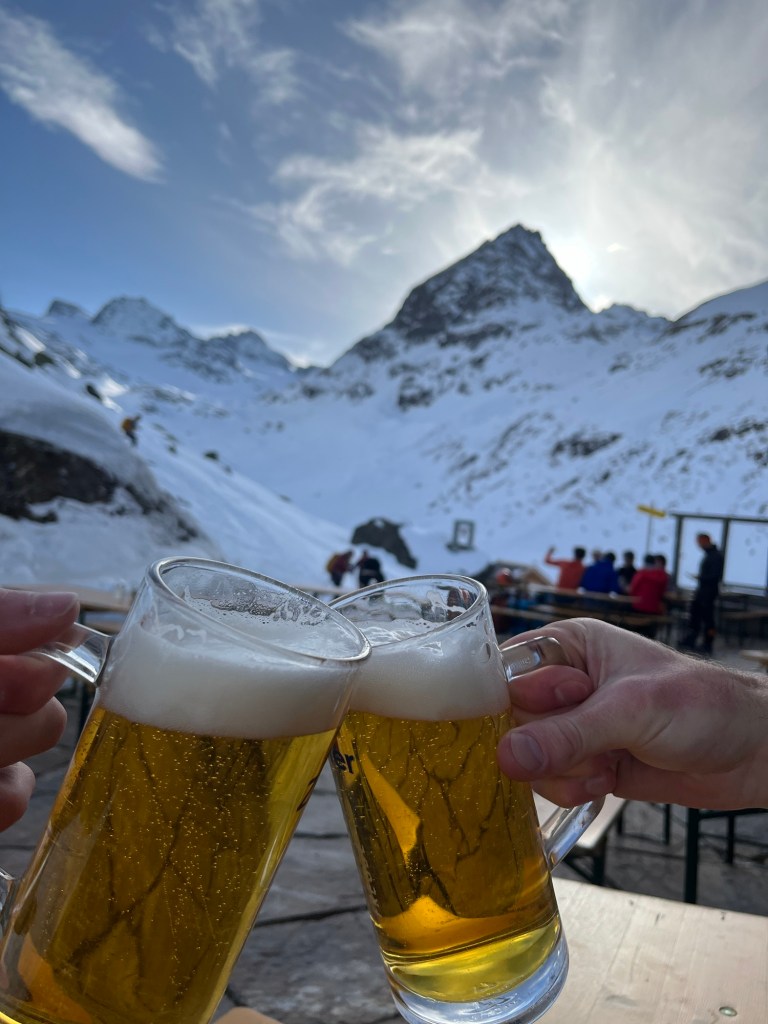
Concluding our day’s journey, the sun was low on the horizon, but its last rays warmed the hut patio, where ourselves and many other trekkers scattered gear and dipped inside the hut, returning with frothy beersteins–cheersing each other in celebration of a successful and safe day of mountain fun. Drinking beer, Allex and I reminisced on the day’s adventure, recalled college memories, and shared philosophies and plans for the future.
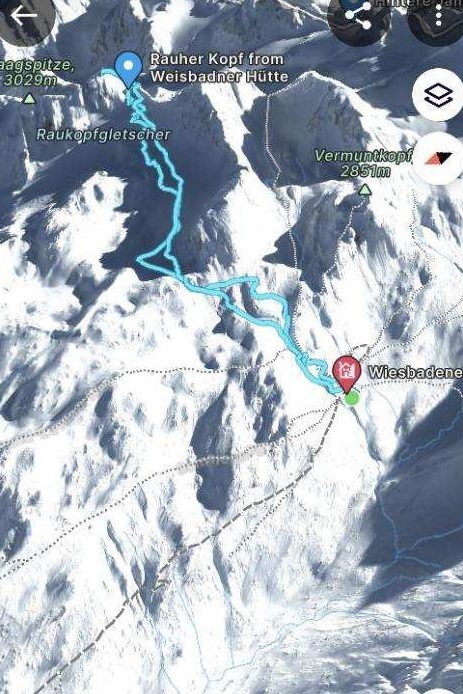
The route for the side trip up Rauher Kopf that we completed on day two of our tour.
From our vantage point on Rauher Kopf, Allex and I had seen into the nearby valley where we were headed next. The jagged peaks, endless chutes, and magnitude of the mountains pulled us onwards to explore the new area. On the morning of day 3, I was relieved leaving Weisbadner Hütte. I wasn’t just excited for the next stage of the trip but I was also getting tired of the spot. Settling up with the hosts the night before, I had been surprised by the balance: the pricing structure for room and board was surprising but we were assured that the bill was correct. For a moment I was worried that we would run out of cash, but we had enough.
Leaving Weisbadner, we voyaged to the south and to the east up a long pass. The sustained climb led me to experiment with different types of ski movements and their efficiency. As we fired up the slope, in spots I kicked out off my skins like a half-assed nordic skier. The glide improved my pace. In other areas, it was best to break through a crust and stomp down on the snow underneath to create a steady platform before pushing off. From behind, a lone skier rapidly gained on us. He greeted us warmly and then continued on his way in a totally different direction. He had come from our original starting spot just that morning and would go a much further before night. This middle-aged Austrian athlete was taking full advantage of his backyard, ranging far between mountain huts. For the first time, I saw the type of athlete and attitude that drove the skimo sport movement and gear evolution, which is less concerned with reaching highly technical descents and focusses instead on moving fast through backcountry and covering great distances. I imagined that this fast and light approach is a natural progression considering the extensive hut infrastructure in place throughout the Alps allows for swift travel without the burden of excessive gear.
Near the top of the pass, Allex spotted a steep, north-facing couiar that we wanted to skin up and earn elusive untracked turns. Caution impelled us to dig a snow pit and gauge stability. Over the next hour we shoveled through the heavy snowpack, revealing and taking notes on the crystalline strata that were revealed. Our journey through this recording of the prior winter conditions showed several weak layers and the deal was sealed at the very bottom where we discovered a depth hoar base. The slab seemed unlikely to go, but if it did, it might bury us deep in an icy grave in front of a small terrain trap at the bottom of the slope. We decided to walk away, safe but disappointed.
Our frustration died quickly. Reaching the crest of the pass, we were rewarded by one long, sweet descent all the way to Jamtal Hütte. Below us we could see a party traveling up what we would travel down. The route first descended to a glacier and then afterwards angled alongside the stream emanating from underneath its icy mass. The continuous traffic and low angle made us confident about the snowpack. Hopturns down the side of the steep and icy ridge gained us the shaded glacier below, where we found soft snow. We cut it loose. Striking a compromise between following the skin tracks to avoid dark crevasses and searching for untouched powder, we rocketed down the pass. I launched off a small boulder and let out howls of joy as we sped along, “Yyeeewwwww!”
Jamtal Hütte is the crown jewel of the Silvretta Traverse. Its surroundings are winter Rivendell; an escape from the machinations of western society where the only responsibility is to explore the high snow fields punctuating the naked sawtooth peaks that enclose and shelter a long, steep valley. The high angles and northern aspects protect the snow from sun. Not only is the valley special, but the hut is unparalleled. We were surprised by automatic doors leading to the main dining area. Smiling hosts rented us towels and sold us shower tokens that lasted for minutes of delicious hot water. Outdoors, a flagstone-paved patio made a welcome resting spot for the afternoon beer. In every direction, there were massive vistas of precipitous peaks. Right from the door you could skin up a chute and get hundreds of feet of good turns. The mood here was jovial.
Day 4:
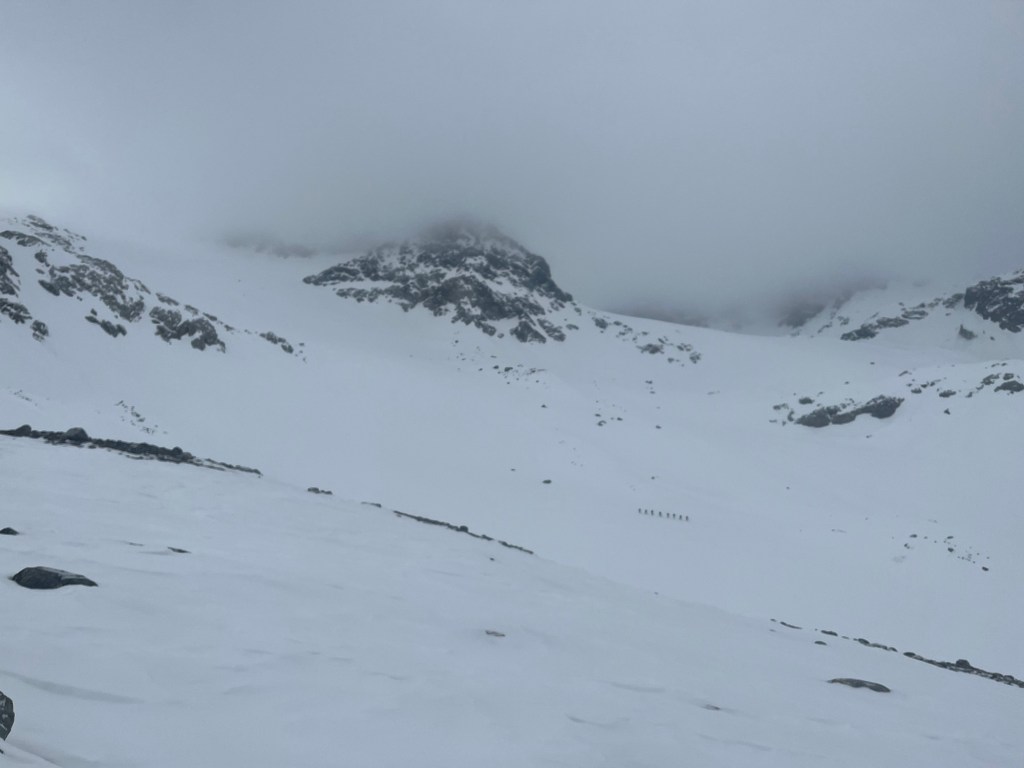
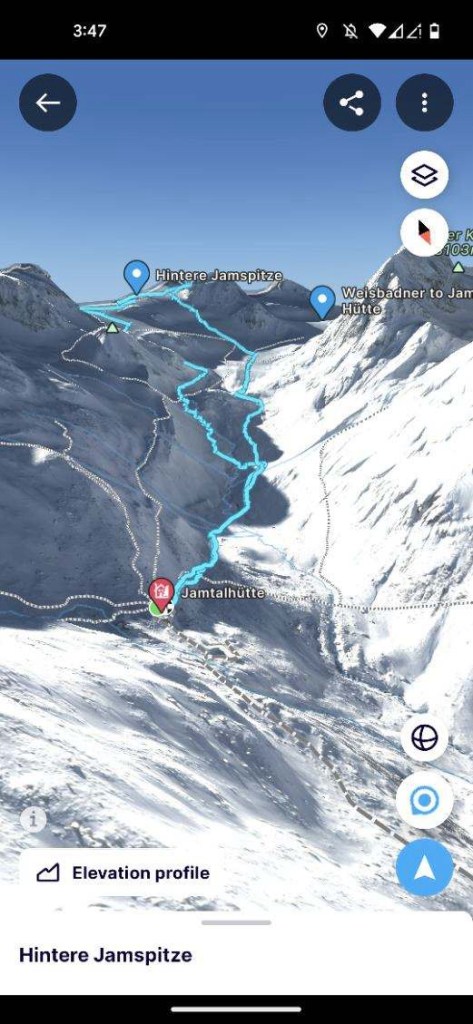
This day stands out in my life. Striking off, I recall a low cloud ceiling and fog occluding our destination. We planned to head up the valley and then up a steep set of mountain faces until we reached mount Hintere Jamspitze on a sharp ridge line marking the border between Austria and Switzerland. The weather was questionable, but the opportunity irresistible. From the top of our destination, we’d be able to ski down a seemingly endless snow field, thousands of feet to descend at once.
A low cloud ceiling and flat lighting as we set out the morning of day 4.
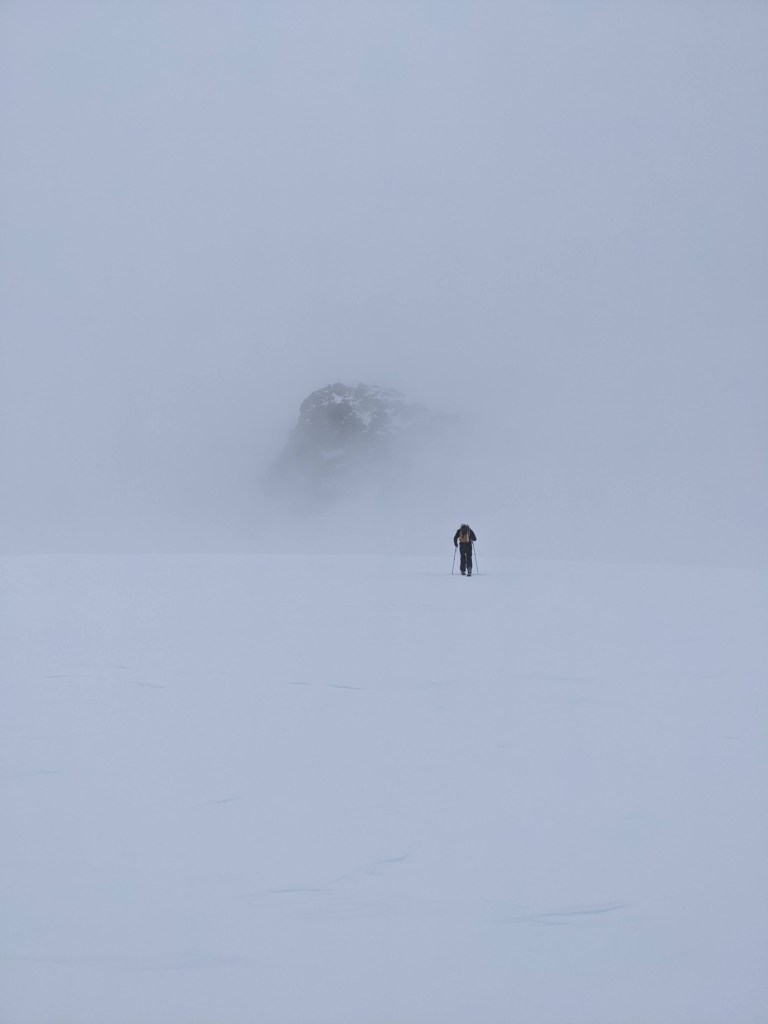
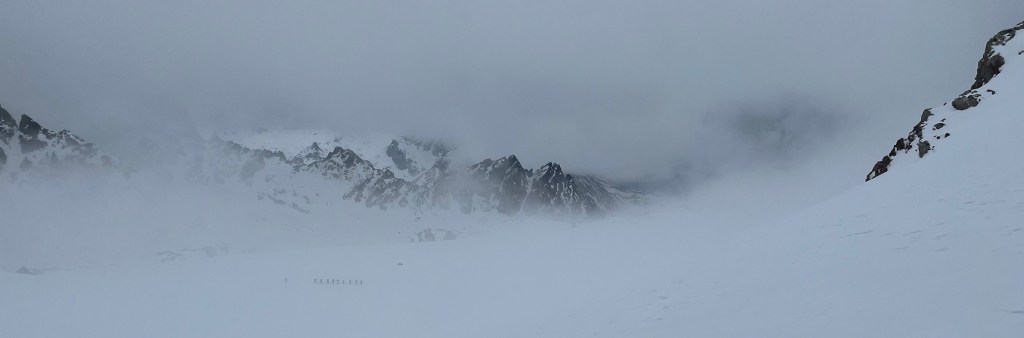
We transected streams, ridges, and rolling hills; navigating around frosted boulder fields. We’d enter side valleys that we hadn’t even realized existed because from a distance they seemed insignificant compared to the larger cirque. The unexpected topography confused our trail but we were reassured by occasional encounters with skin tracks. We were tired from days of physical effort, and when we reached the bottom of a glacier that encompassed the probable next leg, blowing snow and wind chilled us as we stopped to rest, refuel, and contemplate. Conversation was minimal as we considered our strategy for advancing in the near white out conditions that now swept over us.
When we had departed that morning, a large guided tour was ahead of us by about 20 minutes and seemed to be going in a similar direction. Our paths split early, but we often spotted them traveling parallel to us far in the distance. Pride drove Allex and I ahead. The last thing we wanted was to be bested by an entire cumbersome group. This provided spring to our step. We did not stop long on our rest and we headed up the glacier boldly. In the flat light and blowing snow, uphill was our only sense of direction.
A guided tour setting off ahead of us in the morning gave us a pace to beat.
For hours we pushed ahead without point of reference for how far we had come or how far we had left. At some point we departed the glacier, evidenced by unexpected rock bands that we perceived through the fog. We searchingly traversed our way around these bands and continued on our way up, sometimes getting cliffed out and having to turn around. We traveled in this manner with little sense of time until suddenly the face of Hintere Jamspitze broke out of the clouds. Instead of massive, it looked so small. I was disappointed. But my eyes played tricks on me: we were a long ways off and with each stride the naked rock face grew more immense.
Hintere Jamspitze suddenly appears out of the clouds ahead of us.Looking behind, the guided tour only a few minutes behind us gives some much needed size perspective to the massive terrain.
The route ascended into a snow-blanketted meadow directly below the peak. The meadow was crowned by shark tooth rock formations splitting the border between Austria and Switzerland. This place had an aura, an electricity to it. We spotted a fractured rock column extending from the cliff face hanging over Switzerland and we knew we had to get on top of it.
The meadow below Hintere Jamspitze.Once we spotted this sketchy rock pillar, there was no question about getting on top of it to straddle the Austria/Switzerland border in a dangerous manner. A moment of vertigo high in the alps.
I could have spent the day exploring this lofty spot, but the afternoon wore on and the fog was lifting, offering us a promising window for a good descent. I quickly bootpacked up the peak to mark the highpoint and drink in the view, then I came down. We stripped our skins and buckled in.
The expanse of the valley below us.
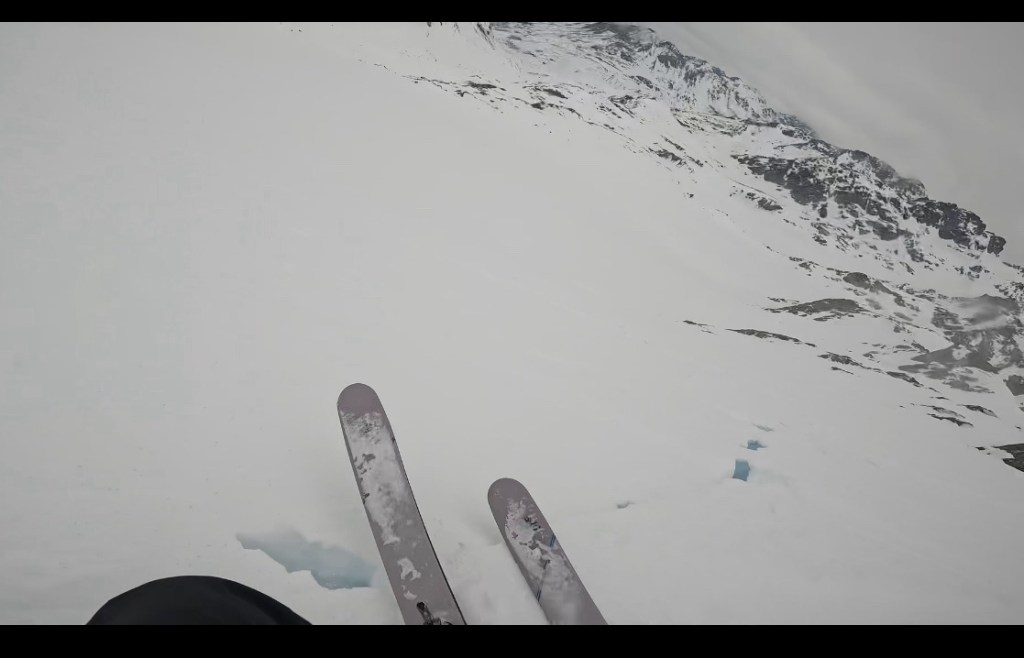
Hard packed chunder covered the initial pitch, which immediately plummeted into a steep grade with softer snow. We threw caution to the wind and charged down the slope. As I carved down, my eyes picked up a break in the snowpack. My skis crossed a small fissure that hid the icy depths of a crevasse below me. I hoped that my speed would carry me over any weakness in the snow bridge I crossed and help me to avoid whatever large emptiness lay below me. The snow held and then that split second was over.
I had probably crossed over a bergschrund, which is a fissure that forms at the top of a glacier where its fluidic mass pulls away from the rocky headwall that marks its starting point. Better inspection of our terrain might have keyed me into the danger.
Scrubbing through GoPro footage I find that I had indeed skied over a crevasse.
Reaching the bottom of our descent, we enjoyed our last night at Jamtal Hütte, ecstatic about our day and about being able to drink beer on the patio. Surprisingly, Adventure groups kept to themselves apart from passing conversation. Perhaps because everyone was already with their best friends and everyone was exhausted.
We’d depart for the last hut in the morning. It felt like our time in the mountains was drawing to a close and I hated to leave this magical place.
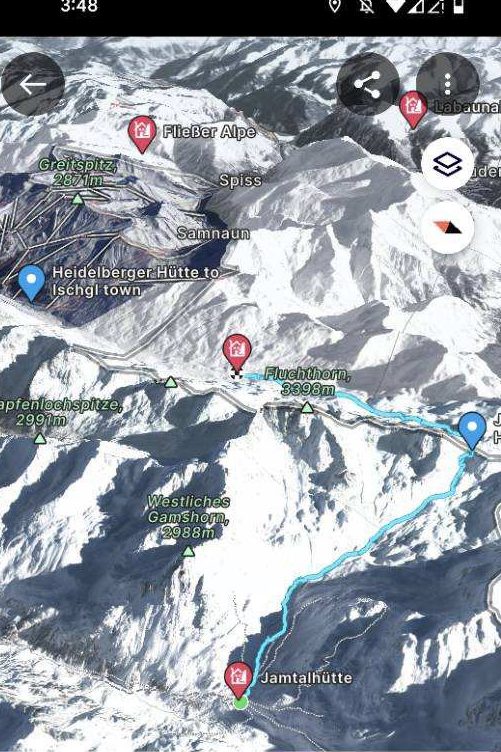
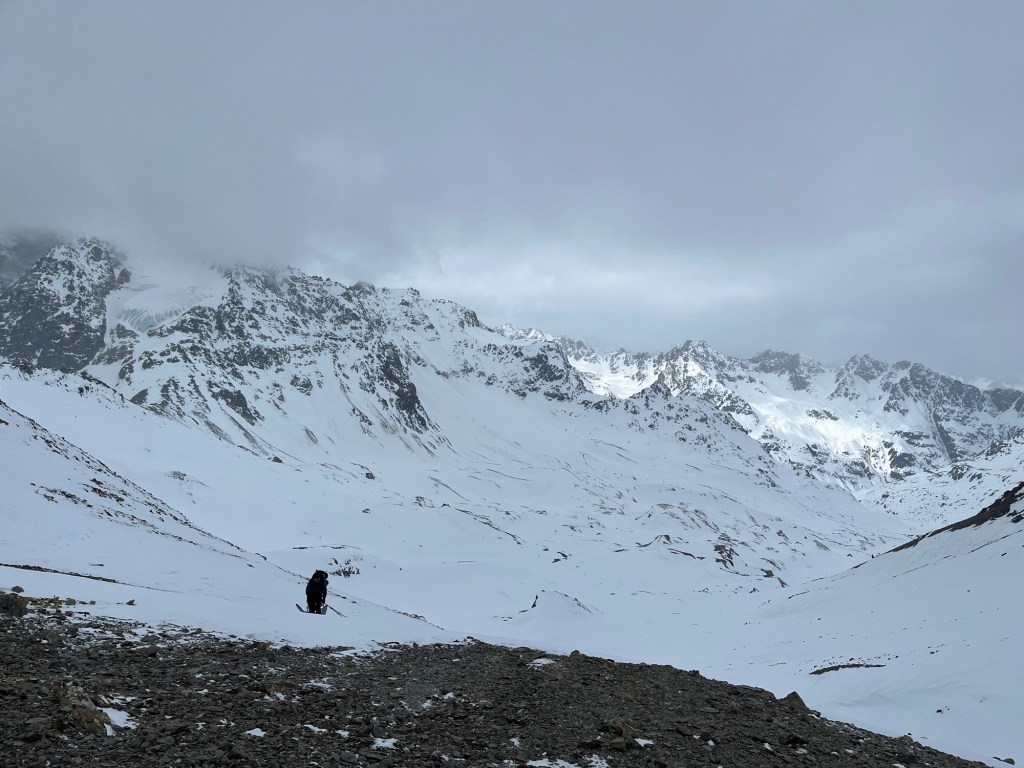
The approach to the final hut we’d stay at.
That next leg of our trek was a long haul up a meandering mountain valley to reach a windy pass, followed by a bit of a descent, and then endless rolling hills down to Heidelberger Hütte. The trip was catching up to me: the absence of recovery time from work before starting the trip; the outlandish journey by plane, train, and foot to our starting point; and of course, four days of skinning up mountain faces. A diet overwhelmingly of pork, summer sausage, and schnitzel held heavy in my stomach, and I was coming down with a cold. I’m surprised I still digested food. The ascent to the mountain pass revealed that Allex was feeling stronger as the trip progressed. I felt the opposite.
Regardless, it was impossible not to appreciate the beauty surrounding us. Many times we stopped to admire the landscape. Sparkling snow crystals graced the banks of a small creek running down the valley. Breaking free from my headspace, I could replace my superficial pains with appreciation for where I was and what I was doing.
I oscillated between admiration and misery as we summited the pass. Windbare scree patches forced us to remove skis and hike. Cold air tore at us. The environment was unfriendly, but we were surrounded by views of unrivaled majesty. We didn’t linger in this harsh environment. Hoods came up, jackets were zipped tight, and we marched on .
Heading up the pass, we were reminded of the majesty of these mountains and we were also rewarded with the potential for frostbite.
The snow was bad on the other side of the pass. We picked our way down the mountainsides, taking care to avoid barren rock fields interrupting the snow cover. Our low energy made the conditions even more dangerous.
The steeps eventually gave way to flat stretches and occasional uphills. We repeatedly stripped skins and then reapplied them. It wasn’t fun. Allex’s experience was testament to how much better backcountry skis are over splitboards in hilly terrain. Allex disassembled and reasambled his board over and over and over as the miles wore on. At one point he tried skiing downhill with his board broken apart, but splitboards don’t have inside edges and it’s a big leap from snowboarding to telemark skiing without edges. He had limited success.
The Gauntlet ended as we finally crested a hill and found ourselves above the hut. We skied down the last pitch in relative style, hiding the awkwardness of the last four miles. We must have looked pretty good because onlookers on the patio asked if we were professionals.
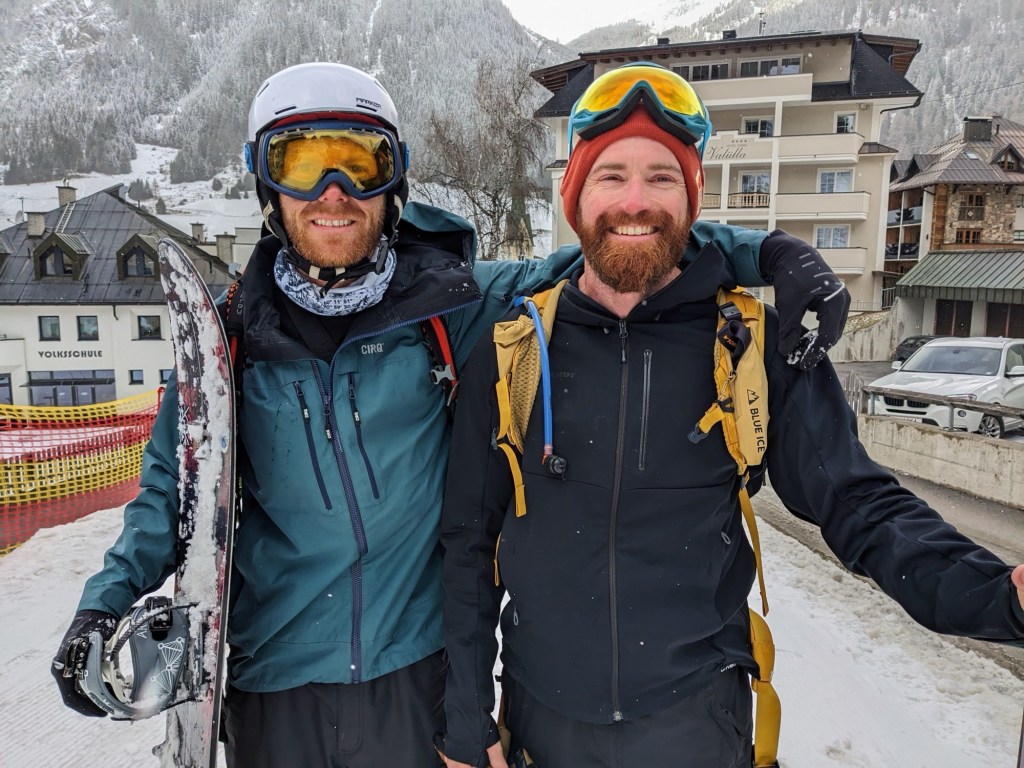
This last hut, as with all before it, had a totally different vibe. A hot shower and some rest, some snacks, and hot mulled wine revived us. Heidelberger Hütte is known for its cuisine and its tenure: over 130 years old. At the bottom of the valley that enclosed us is the ski town of Ischgl, which is known as the Aspen, Colorado of Austria. Most visitors get towed up the valley to Heidelberger Hütte by snowmobile, and these resort softies looked at us in reverence. Our backcountry endeavors were impressive to them, especially without a guide. Our American flat bill hats made us exotic.
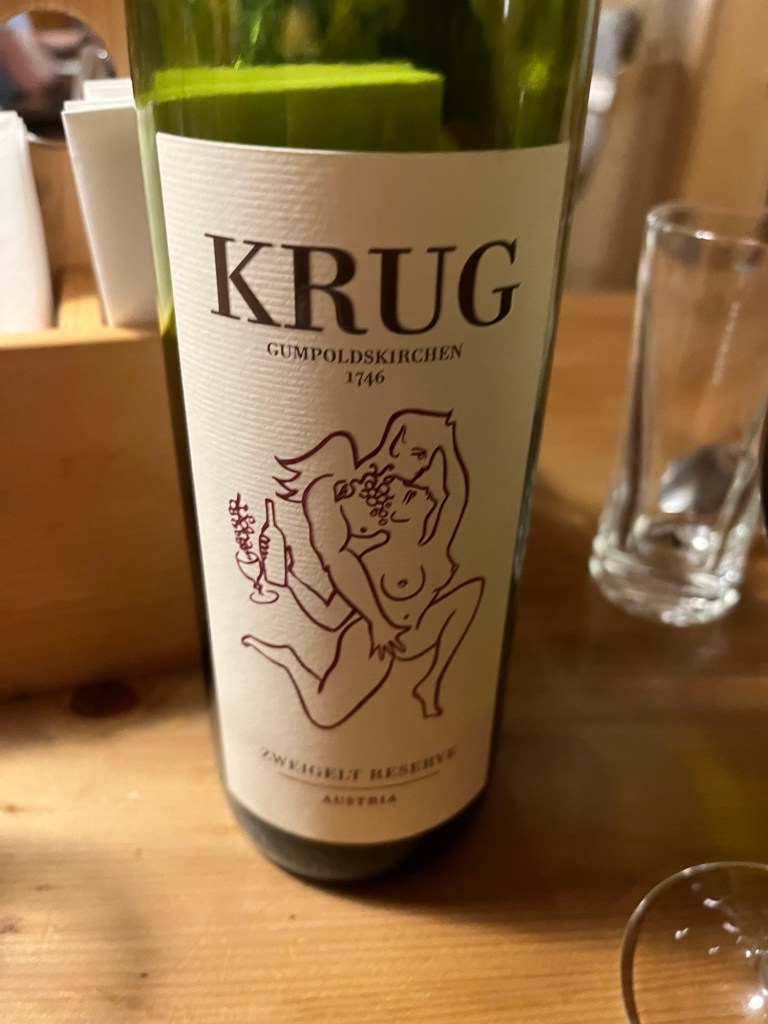
The dinner host was excellent. He shuffled guests to find the most sociable table. He sat us with a group of Dutch (and various other folk) since they’re the best English speakers and some of the friendliest. Cheerful conversation permeated the evening. To celebrate our last night on the tour, we ordered a bottle of Austrian wine that came with a scandalous label. I don’t remember what we ate, but I remember it being delicious. Multiple courses were passed around the table and my appetite was large.
Three inches of fresh snow fell that night. What could have been potentially treacherous but enjoyable in the high country hindered our exit down the valley. We proceeded down the long, flat track for hours–pushing ourselves with ski poles through the fresh powder. I got tired of skinning and skate skied awkwardly on my heavy backcountry gear. Allex didn’t have that luxury on the split board. At one point we pirated a ride on a rope tow that paralleled our path. On the last leg, things finally got steep enough to buckle up and glide into Ischgl in one last victorious descent. We romped around Ischl briefly while we waited for a bus to take us away. We were tired but totally satisfied. What a trip.
The last descent into Ischgl. Victory is at hand.
Return to Munich was bittersweet, Tanya was super glad to see Allex. I wish I’d had more time to hang out with them. We all had dinner together and I departed in the morning. The overall journey was like a tactical operation: in and out. US-Munich-Austria-Switzerland-Austria-Munich-US. From conception to completion in a matter of months. It was hard leaving behind my homie and this tremendous adventure, but I’m grateful to have had the opportunity. Now I carry these memories that make me excited for a new adventure, and a new adventure is never far off.
I’m surprised by the unexpected reassurance from the barista. In my mad dash gathering gear and making way to my friend’s house for an on-time departure on our climbing trip, I had rushed to The Daily coffee shop and asked them to grind the wrong bag of beans for my french press: decaf, a nearly inconsolable mistake. “Grab a different bag, we want you to be caffeinated,” the barista continues. “Yes,” I finally agree. “Thank you.”
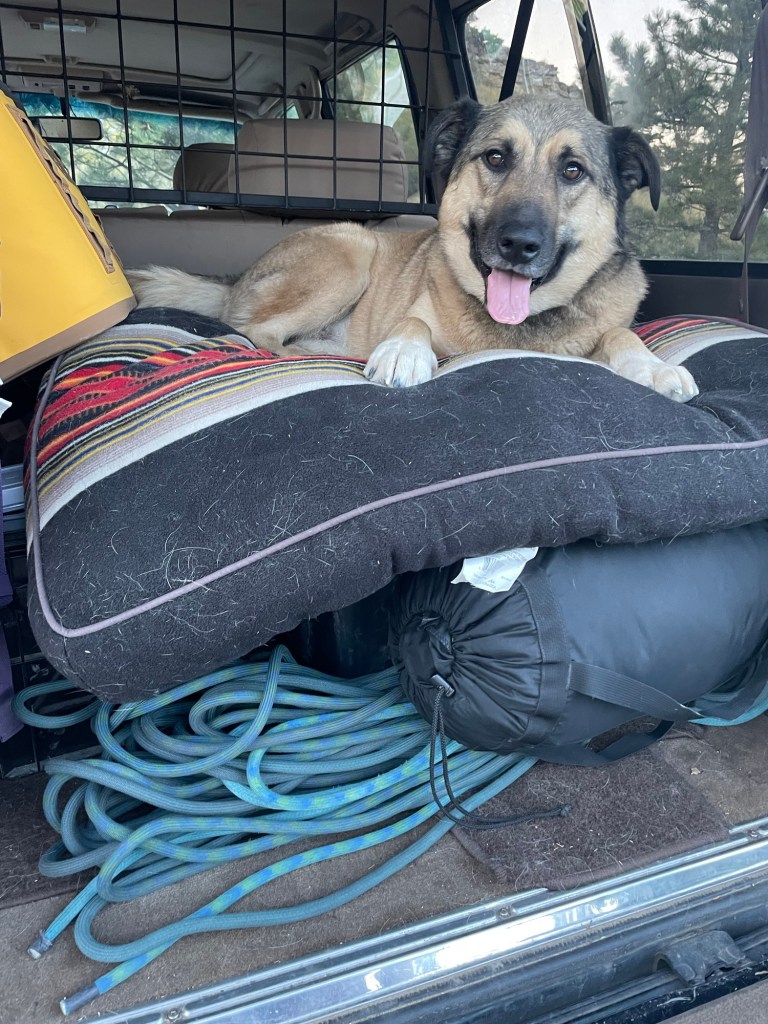
Now, with the correct provisions and buoyed by the kind demeanor of the barista, I reach Cam’s place ready for adventure. Cam, Paige, and I consolidate our gear and shape it into a platform topped by a dog bed in the back of Paige’s 1997 Toyota Land Cruiser so that their pup, Huck, can ride along with us comfortably. Then, we make off into the Montana countryside. On the highway, we cruise past Livingston–a train track town that’s one part hopeful and peppy and another part backwater and forgotten. Soon after, we exit the highway and the road leads us into a deep river valley nestled between the steep hillsides of the Beartooth Mountains.
Huck dgf. Photo credit: Cam Dudiak.
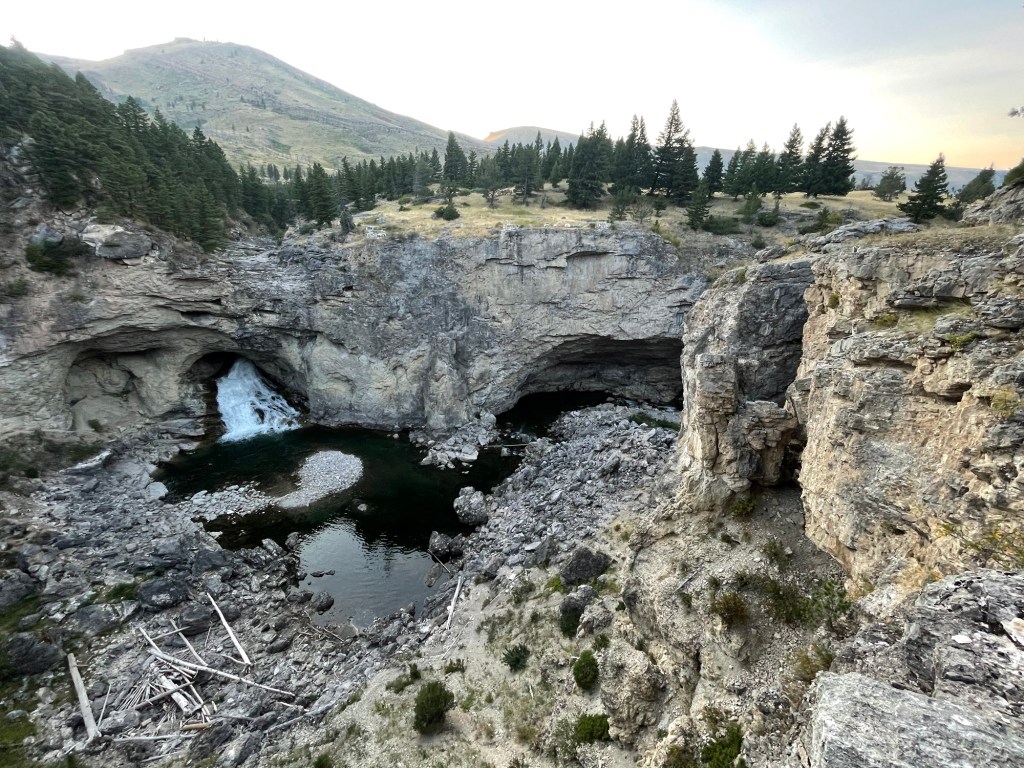
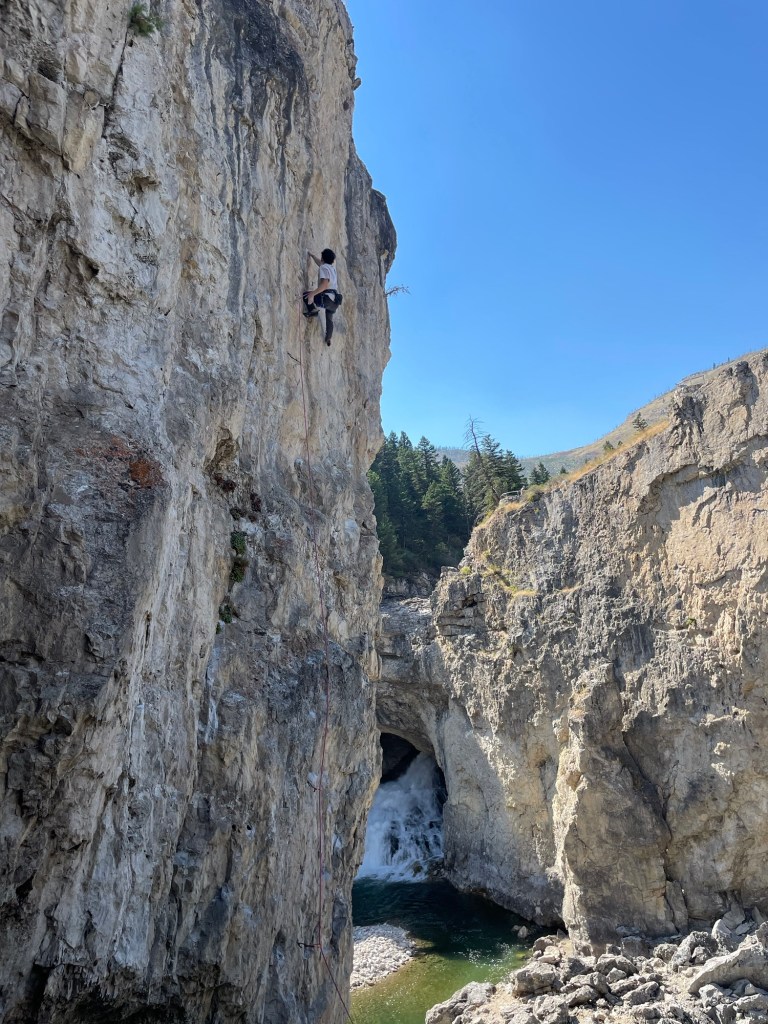
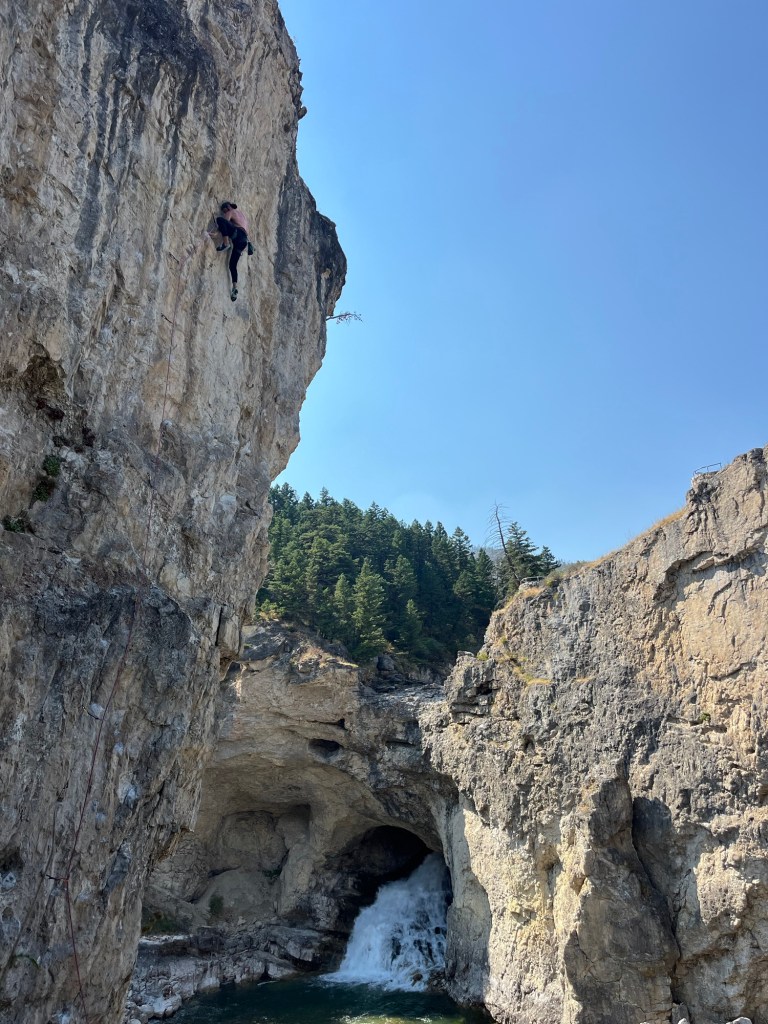
We set up camp before heading to the crag, which is in a spot that the Boulder River hits a shelf of limestone and the entire river is swallowed up by the porous rock–until 100 yards downstream where a deep amphitheater is formed by limestone cliffs. Here, the river escapes its cavernous path and comes cascading out of a deep cave that has been carved by torrents of water across unknown millennia. It is along the walls of this amphitheater that Montanans have established some of the steepest sport climbs in the region. Below the waterfall, there is a deep pool breached by a sandy peninsula. Visitors scramble down a nearby hillside to reach this spot and jump into the cool waters. As a climber, while scaling the surrounding cliffs, the muted thundering of water washes away the worries and trappings of industrialized society. There’s no cell service here. It is perfect.
Photo credit: Cam Dudiak.
This crag is where Cam, Paige, and I have come not only to relax and enjoy nature for Labor Day weekend but also to engage in a cathartic struggle with internal obstacles. We use rock climbing as a medium to explore our physical and mental capacity, to find and surpass our personal limitations. Cam seeks to exceed a brilliant track record as an athlete and climb harder grades than he has in years past. Paige works to overcome the fears that accompany being a new lead climber (fears that seasoned climbers know will never leave completely). I search for a connection to my body and my surroundings that comes from full physical effort in the exposed environment of a cliffside. I’m also hoping for the bragging rights of a difficult send.
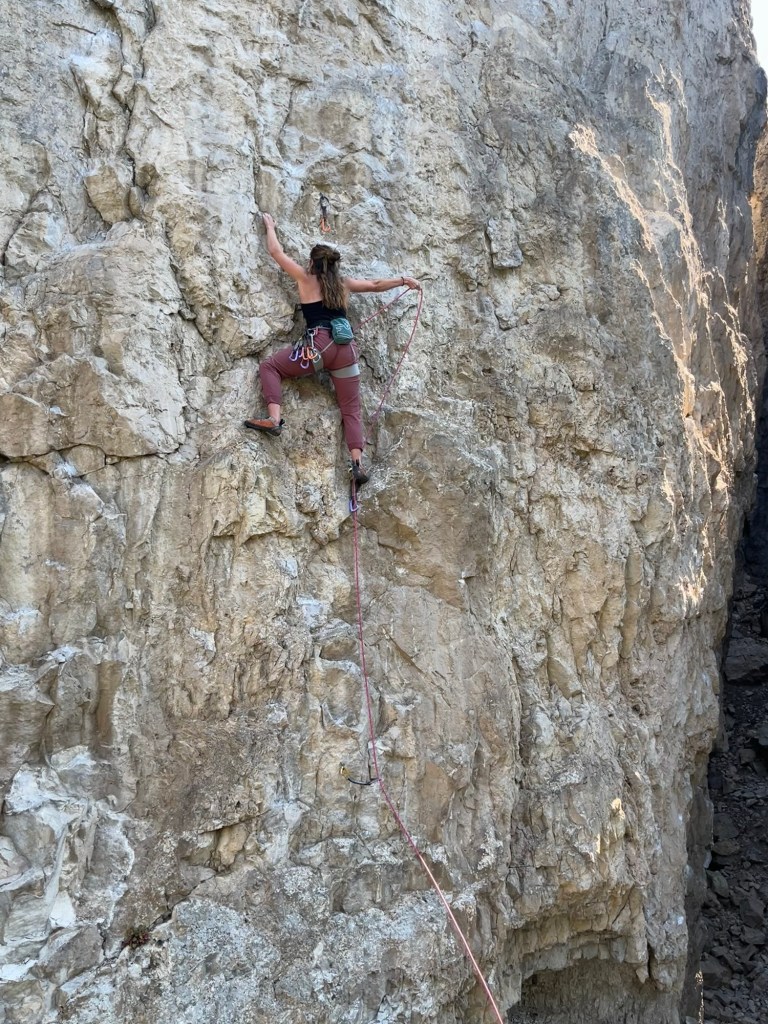
During the next several days, Paige impresses us by committing to bold sequences. It’s clear that she has a great deal of mental fortitude. At one point she moves well above and to the left of her anchor point onto a thin and slabby crux. She’s rewarded by a long fall, a swing, and an unfortunate introduction to the cliff face. She’s OK. Even more impressive than her climbing is her willingness to return to the rock and continue pushing herself on the sharp end of the rope, which she does for the remainder of the trip.
Paige navigates the crux of Hillbilly Heaven.
Cam leads our assault on the stiffer grades. He is unafraid to push himself and willing to battle his way up some of the hardest climbs in the area. He pulls the moves on several 5.13’s including “Whitewater”, a route that ascends the prow of an enormous overhanging block directly in front of the waterfall. It’s an amazing setting. Cam’s enthusiasm fuels my own, and I’m grateful for the opportunity to top rope the difficult climbs after he leads them, turning the routes into some sort of fantastic outdoor climbing gym.
Cam shaking out on a jug after the crux of Adventure Time. Photo credit: Paige King.
My lack of difficult sends on the trip does not keep me from experiencing what I came for. The hard climbing tests me mentally and physically. Through successive burns on an overhung endurance route, I discover that I am over-gripping the living bejesus out of the limestone holds. During my first burn on “Adventure Time”, I am so pumped at the top I can barely close my hand. I grab draws at nearly every clip. The next day, I have familiarity with the holds and I realize the falls are probably clean. This gives me the courage to climb lightly and more confidently. Starting on the climb with fresh eyes, I relax and feel weightless even on small crimps. While I don’t quite send, the route suddenly feels within my wheelhouse.
I test out my hip mobility on Adventure Time. Photo credit: Paige King.
I learned two important lessons on this outing: the first is that my climbing is not limited by strength but instead by using too much of it unnecessarily. The second lesson is that I can recover from being massively pumped and go on to climb multiple hard routes in a single day. Both of these discoveries make the sport seem more sustainable and enjoyable, and they give me something to work on.
After two chalk-full days of try-hard, cold beer, warm wine, frigid river water, and pupper adoration, we head home. I’m excited to apply my lessons learned and looking forward to the next adventure.


 Asa Space